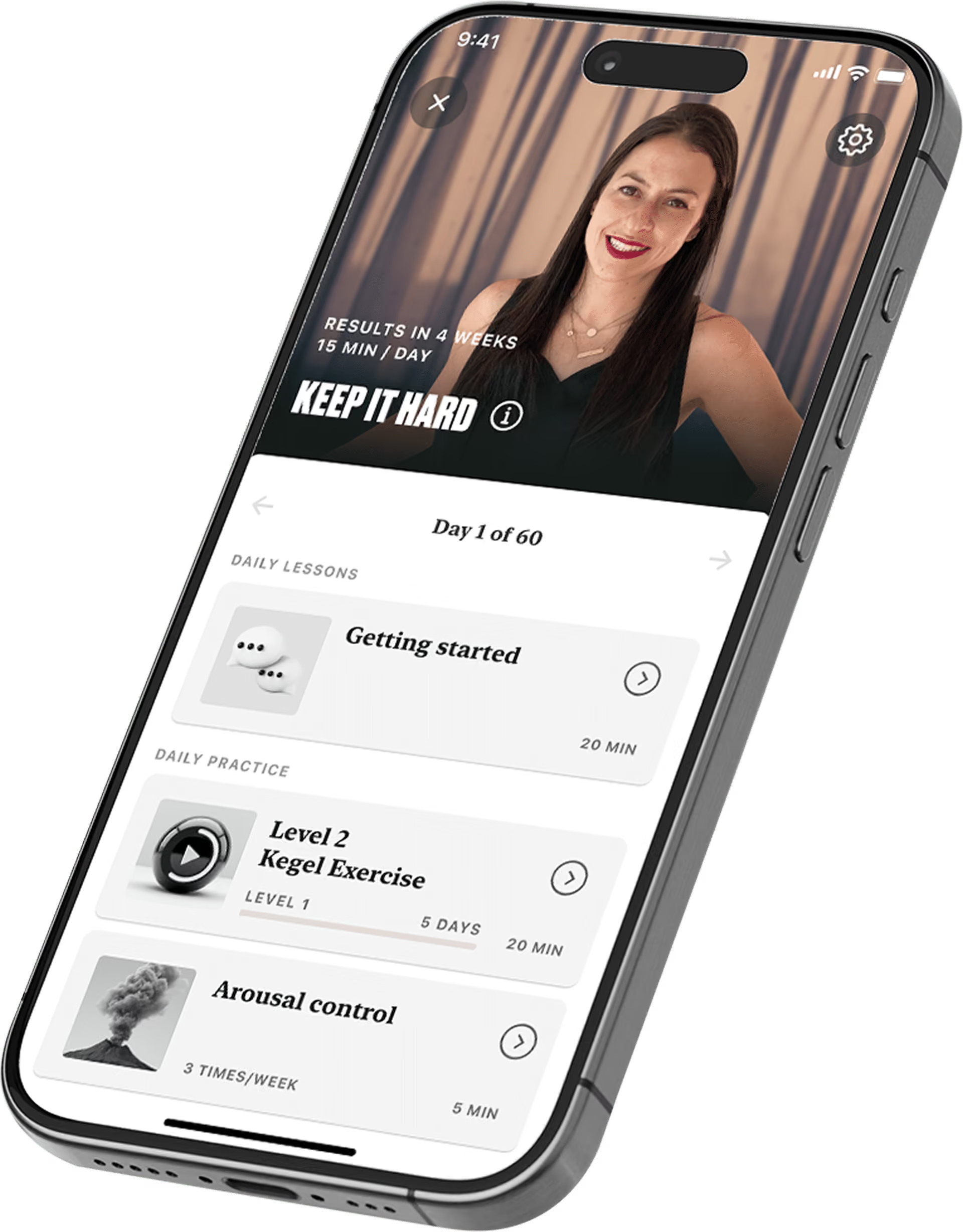
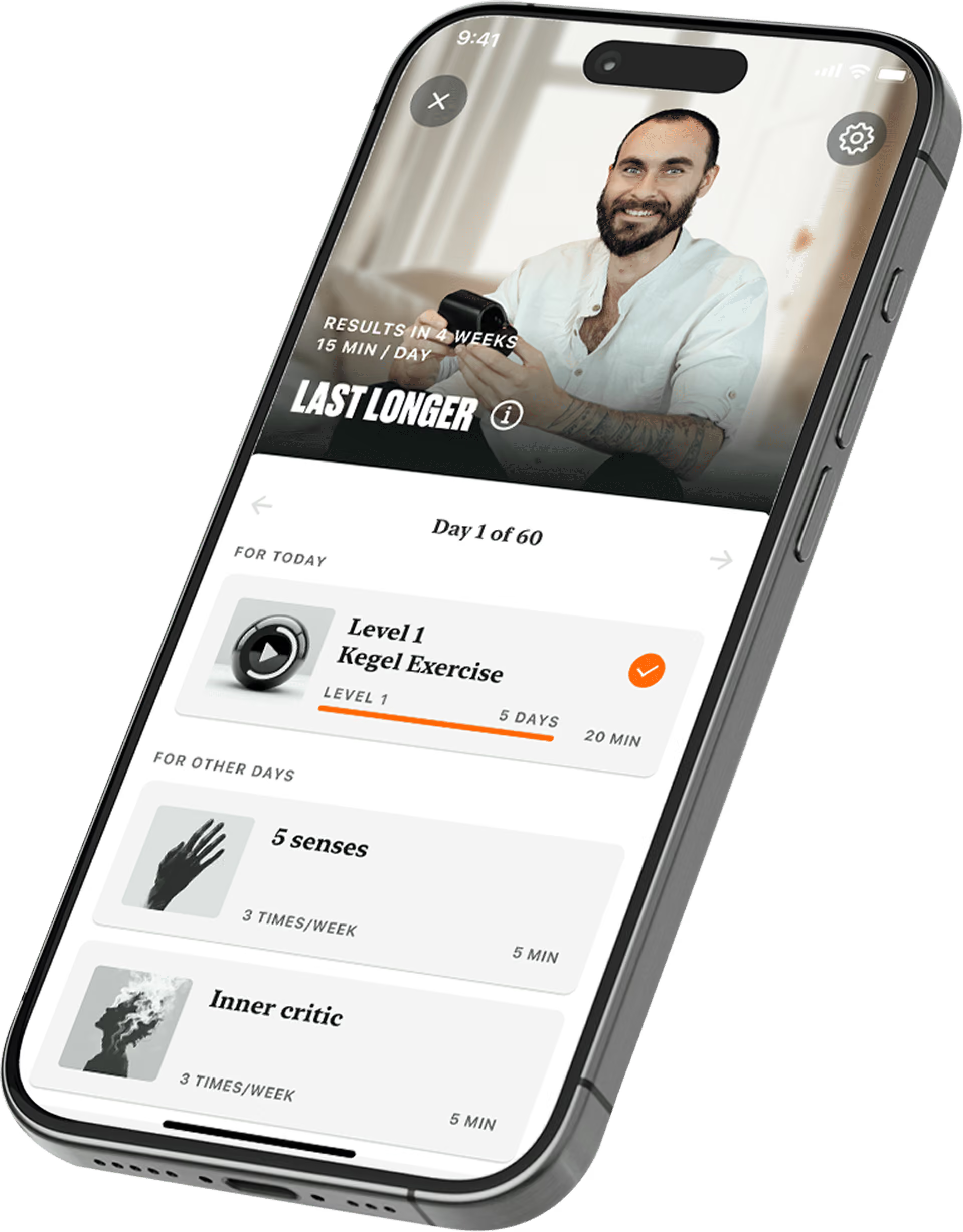
The bulbocavernosus muscle, also called the bulbospongiosus, and the ischiocavernosus muscle are two small pelvic floor muscles at the base of the penis. During an erection they press on the base of the penis and the roots of its erectile tissue, which helps keep blood in and makes the erection firmer. The bulbocavernosus also pushes out semen when you ejaculate and the last drops of urine after you pee. Neither muscle can be trained on its own, but pelvic floor exercises, often called Kegels, work both of them along with the rest of the pelvic floor. Keep It Hard, a program in The Coach app, includes a short check that shows whether your pelvic floor is tense or weak, and sets your training to match.
Answer a few questionsYour pelvic floor is a group of muscles that runs from the pubic bone at the front to the tailbone at the back. Its deeper layer supports the bladder and bowel. Its outer layer lies just under the skin of the perineum, the area between the scrotum and the anus, and that is where the bulbocavernosus and ischiocavernosus sit.
Here are the two muscles, the deeper muscle they work with and the nerve that controls them:
For the pelvic floor as a whole, our guide to pelvic floor exercises for men explains what each part does and how to train it.
An erection starts when arousal makes the blood vessels in the penis relax and its erectile tissue fills with blood. The pelvic floor muscles then help keep that blood in by pressing on the veins that would let it drain away. Here is what the bulbocavernosus and ischiocavernosus do, and why you can train them:
If your erections start well but fade too soon, a problem with the veins themselves can be part of the reason, and our guide to venous leak explains how doctors check for it.
Because the pelvic floor helps keep blood in the penis, its condition matters. If the muscles are weak, blood can drain too soon and an erection is harder to keep. If they are too tight and can’t relax, they may press on the artery that brings blood in, and they can make the genital area more sensitive or less sensitive than usual.
Here are the signs of each and what commonly causes them:
Keep It Hard includes a short checklist that shows whether to start by relaxing your pelvic floor or by strengthening it, and your training follows from the answer. A few questions set up your personal plan.
You can’t see these muscles, but you can feel them work. Before you train them, make sure you’re tightening the right ones.
Any of these four checks will help:
Once you can find the muscles, our guide to Kegel exercises for men explains how to build up your training.
Pelvic floor training is simple, but these six mistakes make it less useful:
There’s no bulbocavernosus muscle exercise that works that muscle alone: every pelvic floor squeeze trains the bulbocavernosus and ischiocavernosus together with the deeper muscles. If you have signs of a tense pelvic floor, spend the first three weeks on relaxation and the opening stretch, and add the squeezes once the tension eases. If you have pain, have it checked by a doctor or a pelvic floor physical therapist before you start.
Do the routine once or twice a day, lying on your back:
In Keep It Hard, the stretch and the Kegel workouts go into your daily plan, and reverse Kegels join them after your first week of training.
Find the muscles, learn whether they need relaxing or strengthening, then train them steadily.
Keep It Hard is a program for men who want stronger, more reliable erections. Its 17 lessons cover how erections work, anxiety, the pelvic floor and sex with a partner, and practice takes about 10 to 20 minutes a day. It doesn’t diagnose or treat medical causes; that’s your doctor’s job.
Eight questions about pain, your bladder, your bowels and sitting decide whether you spend the first three weeks on relaxation or go straight to strength training.
A stretch before each session, Kegel workouts in your daily plan and reverse Kegels from the second week.
A solo exercise that starts with squeezes at different strengths and teaches you to let an erection fade and come back.
Your answers decide which practices your plan starts with. From then on, Keep It Hard sets out what to do each day, pelvic floor workouts included.
Some signs call for professional advice before you train, or alongside training. A physical therapist who specializes in men’s pelvic health can assess how your muscles work and correct your technique. See a doctor or a pelvic floor physical therapist if:
To read about the other causes of erection problems and how doctors look for them, see our guide to erectile dysfunction.
Regular training makes the pelvic floor muscles stronger, so they squeeze harder and hold a contraction longer. When a weak pelvic floor is part of the reason your erections fade, that can help them stay firm.
Training doesn’t repair blood vessels or nerves, and it doesn’t treat the medical causes of erectile dysfunction. If one of those is involved, the muscles can support your erections, but a doctor needs to look at the cause.
Strength comes from steady practice, not from a few hard sessions. Your weekly hold time shows whether the muscles are getting stronger.
These figures come from a survey of The Coach users after their first four weeks. They show what users reported, not a result every man will see.
An erection needs a pelvic floor that can hold blood in and a body calm enough to let arousal build. Stress sets off the fight-or-flight response, which sends blood away from the penis, so training the muscles alone leaves part of the picture out. Keep It Hard pairs pelvic floor workouts with breathing and relaxation exercises in one daily plan, which the quiz sets up.
Reviews from men using the app, in their own words.
“I’ve been using The Coach app for about 3-4 weeks now, and I’m genuinely impressed with the results. The app is super easy to follow. The daily pelvic floor (Kegel) exercises are short, only 5 to 10 minutes each, and they’re split nicely: one session in the morning and one in the evening. This makes it very easy to stay consistent without feeling overwhelmed.”
“EXPERIENCE THE COACH Before signing on to the coach I struggle have erection. I started using the coach in the first week of January, 2026 and by the 2nd week I’d already started seeing improvement in my erection. The Coach is not only about kegel exercise but is a complete package and includes psychological , emotional and physical exercise as well and this has improved my wellbeing in all these areas.”
“I have known all these exercises for a while but I was not able to stay consistent for a long time. I like that the app is engaging and makes you keep coming back to do your workouts. I also like that includes breathing exercises and psychological aspects as well. So it is all in one.”
“My experience with ‘The Coach’ app has been very good. The lessons and exercises have helped me tremendously. I am much more confident both within myself and also with my appearance. Intimate moments are not so anxious as before because I follow the helpful advice given in the ‘The Coach’ app.”
Keep It Hard was developed with specialists in men’s health, among them urologists, an internal medicine doctor, physical therapists, a sex therapist and a sex coach.
Gerard Greene
Specialist men's health physiotherapist and senior lecturer at Coventry University.
Dr. Susie Gronski
Licensed physical therapist, certified sexuality counselor, and founder of a men's pelvic health clinic.
Natalie Goldberg
Certified sex and family therapist dedicated to improving intimate relationships and personal well-being.
Dr. Amy Pearlman
Board-certified urologist specializing in male sexual wellness, performance, and hormonal health.
Dr. Justin Houman
MD, UCLA-trained urologist and male reproductive specialist focusing on sexual health.
Cameron Fraser
Australia's leading men's sex coach, specializing in male sexual wellness and performance.
Ben Greenfield
13-time Ironman triathlete, bestselling author, and recognized expert in health, fitness, and performance.
Dr. Gary Shlifer
DO, board-certified internal medicine physician specializing in preventative care, nutrition, and anti-aging.
Yes. Bulbospongiosus is the name used in current anatomy books, and bulbocavernosus is the older name, still common in medicine. Both mean the muscle that wraps around the bulb of the penis.
It’s a reflex doctors test to check the nerves in the lowest part of the spinal cord. The doctor gently squeezes the head of the penis, or tugs on a urinary catheter, and checks whether the muscle around the anus tightens in response. It’s a medical test, used, for example, after a spinal injury, not something you train.
No. BC is short for bulbocavernosus, the muscle around the base of the penis. PC is short for pubococcygeus, a deeper muscle that runs from the pubic bone to the tailbone and supports the bladder and bowel. They work together, and a Kegel squeeze trains both.
Not really. The ischiocavernosus tightens together with the bulbocavernosus and the rest of the pelvic floor. Imagining that you’re lifting your penis, not only holding in urine, helps you feel the front of the pelvic floor, where these two muscles sit. Our guide to exercises for erectile dysfunction shows where this training fits among the other exercises.
Yes. When you come, the bulbocavernosus contracts in quick waves that push semen out, and the ischiocavernosus tightens too. Pelvic floor training is also used to help men gain more control over when they ejaculate.
Yes. Regularly holding in urine or bowel movements, intense core training, stress and some pelvic pain conditions can leave the muscles tense and unable to relax. In that case, the first step is learning to relax them, not squeezing harder, and our guide to reverse Kegels explains how. Pain is also a reason to see a doctor or a pelvic floor physical therapist.
No. The pelvic floor workouts, the stretches, the breathing exercises and the arousal control exercise are all done alone. The lessons on foreplay and positions are for when you have a partner.
About 10 to 20 minutes. Some practices are daily and others a few times a week; your plan shows what to do each day.
In Keep It Hard, a short checklist shows whether your pelvic floor needs relaxing or strengthening first. Your daily plan then combines the matching workouts with breathing and arousal control exercises, in about 10 to 20 minutes a day. A few questions get you started.