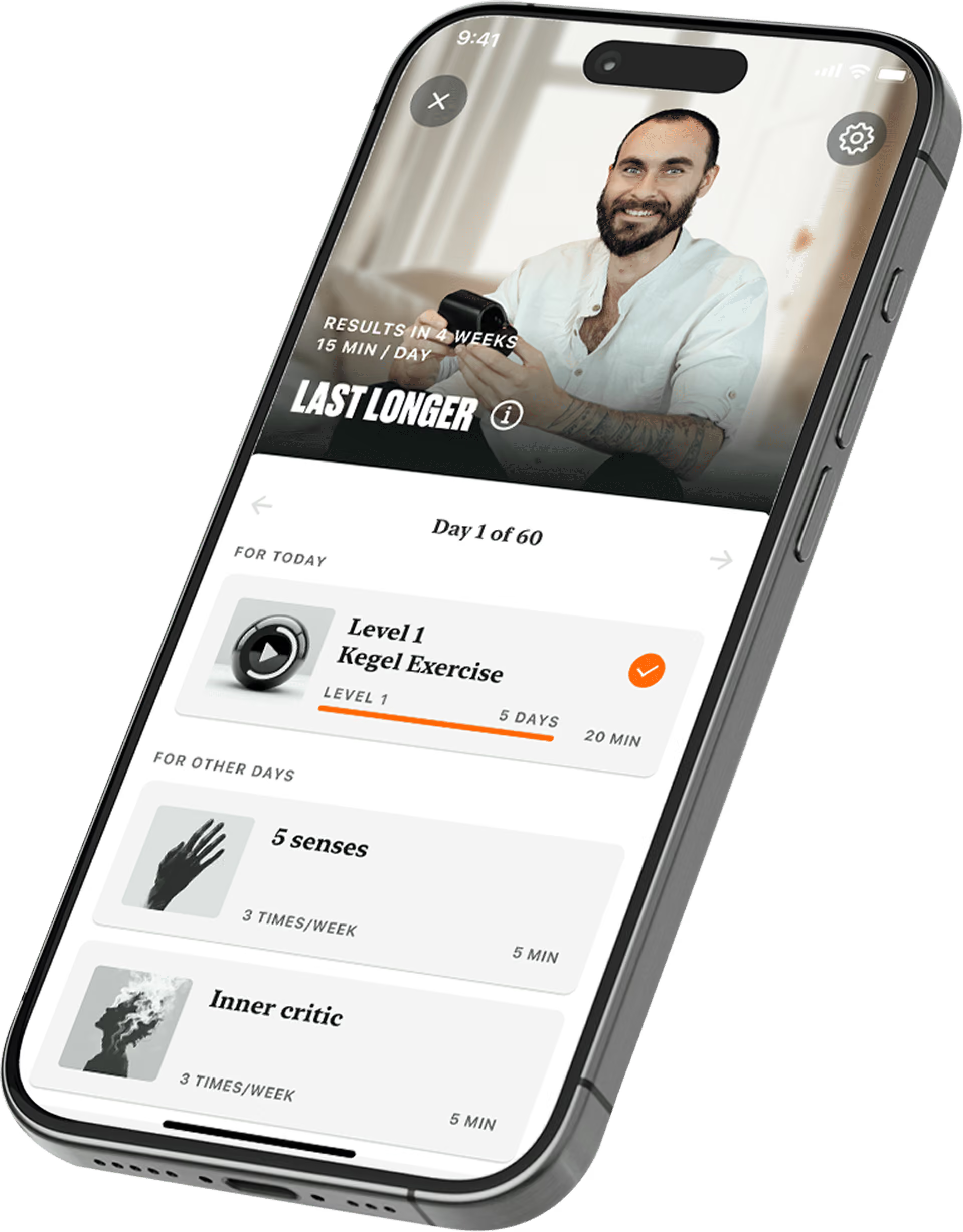
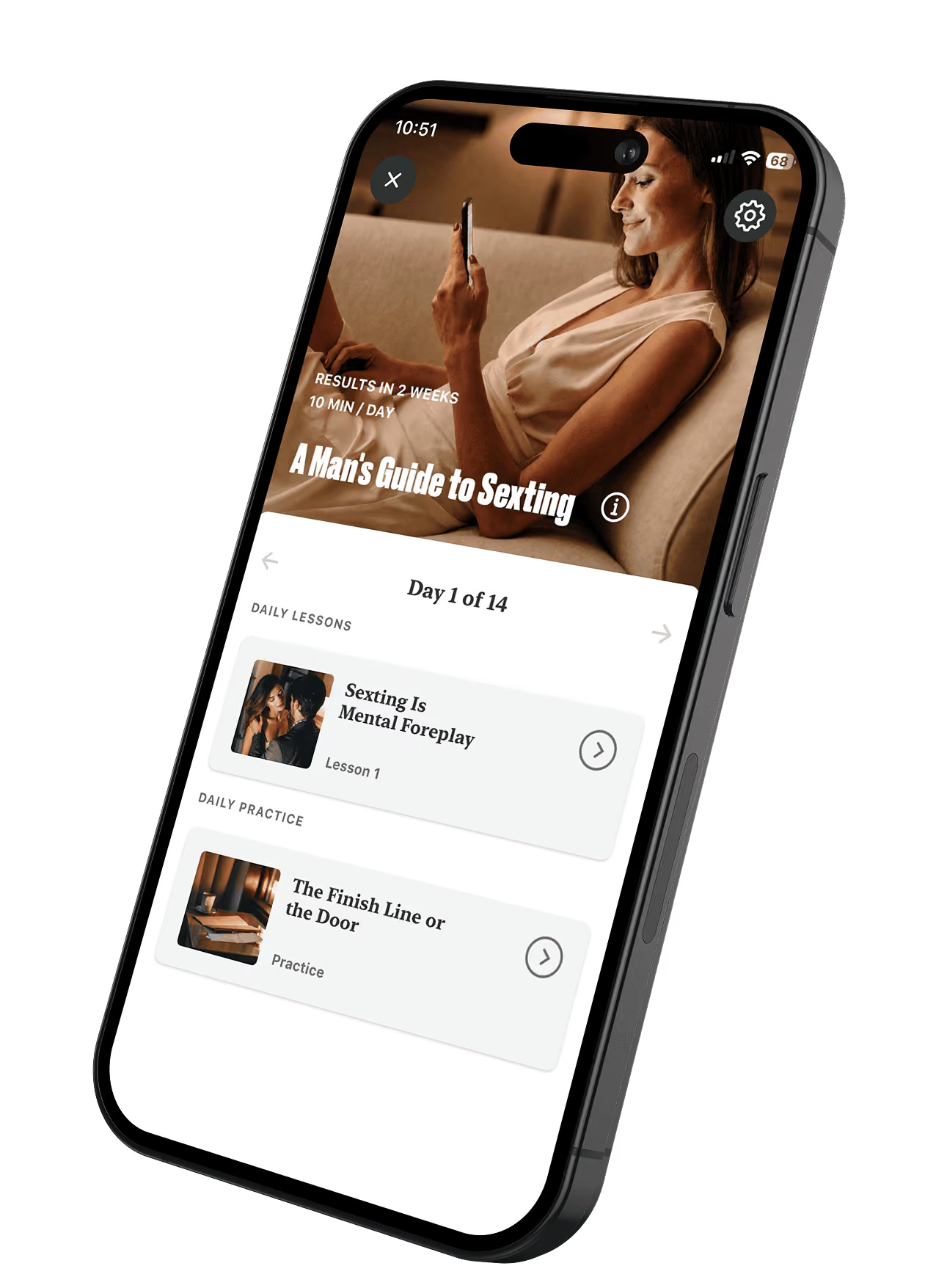
The stop-start technique is an exercise for lasting longer in bed. You stimulate yourself until you’re clearly aroused, slow down or stop before you get too close to orgasm, let the arousal fall, and then start again. Repeating that cycle teaches you to notice how aroused you are and to bring the arousal down in time. Last Longer, a program in The Coach app for men, uses it as the first step toward staying in control without having to stop.
Take the quizThe stop-start method trains you to control your arousal by letting it rise and fall on purpose. You may also see it called the start-stop technique, the start-stop method, the stop-and-start technique or the stop-and-go method.
It is usually described as a stop-start method for premature ejaculation, but you don’t need a diagnosis to use it. It helps with two things that often go together: not noticing how aroused you are until it’s too late, and never having practiced bringing arousal down. If the problem started suddenly or comes with pain or erection trouble, see a doctor first.
The exercise uses a scale from 1 to 10 to rate how aroused you are:
Finishing sooner than you want can have several causes, and we go through them in our guide to premature ejaculation.
Start alone, by hand. Solo practice is sometimes called start-stop masturbation: you masturbate with a goal: to learn your arousal levels and how to control them. Leave porn out of these sessions. If you train with it, you can get used to becoming aroused by particular images and find it harder to get aroused with a partner.
A session is the same round repeated 5 to 10 times, and it takes about 20 minutes in total. Three sessions a week for two weeks is a good schedule. One round goes like this:
If you go too far in a session and ejaculate, that’s not a problem. Pay closer attention next time, and you’ll learn the small signs that orgasm is near. Once the exercise feels familiar, you can add a firm squeeze of the head of your penis for the moments when you reach level 9 anyway. We explain it in our guide to the squeeze technique.
Move on to partner practice once you can do the solo exercise reliably. Talk about it first: explain what you’re going to do and why. There’s nothing to be embarrassed about, and the exercise only works if your partner knows the plan.
Then ask your partner to stimulate you with their hands or mouth only. You say “stop” and “start”, and your partner follows right away. In each round, go up to level 8, relax, come down to 2, and build up again. Keep going for at least 20 minutes, and do it three times a week for two weeks.
Penetration comes last. Before you try stop-start during intercourse, learn one more exercise, first alone and then together: holding one level of arousal.
Last Longer lays out solo and partner practice week by week. To get a plan that fits you, answer a few questions in the quiz.
Six habits make the stop-start exercise less useful, and each is easy to correct.
Stop-start teaches you to read your arousal and bring it down, but it does this by interrupting the stimulation. The next exercise takes the interruption away. It’s called plateauing: you stay at one level instead of going up and down.
Bring yourself to level 5 or 6 and try to stay there. If the arousal climbs, slow down and breathe. If it fades, add a little stimulation. You can also change how your hand moves, touch a different area, or shift your attention to another part of your body. Try to hold the level for 20 to 30 seconds, then come back down. Practice on the same schedule as before, three times a week for two weeks, and aim to stretch that time from 30 seconds to two or three minutes.
This is where all of this training leads: staying close to orgasm for as long as you want, without needing to stop. Up to level 8 you do it with breathing, relaxation and attention to your level. From level 8 on you do it with a strong contraction of your pelvic floor muscles, and that only works once regular Kegel exercises have made those muscles strong.
Last Longer puts these steps in order, from the first stop-start sessions to control during sex. The quiz is how you find your place in it: you answer a few questions about your situation and get a plan based on your answers.
Stopping shows you where your limit is. The rest of the training is about staying under it without having to stop.
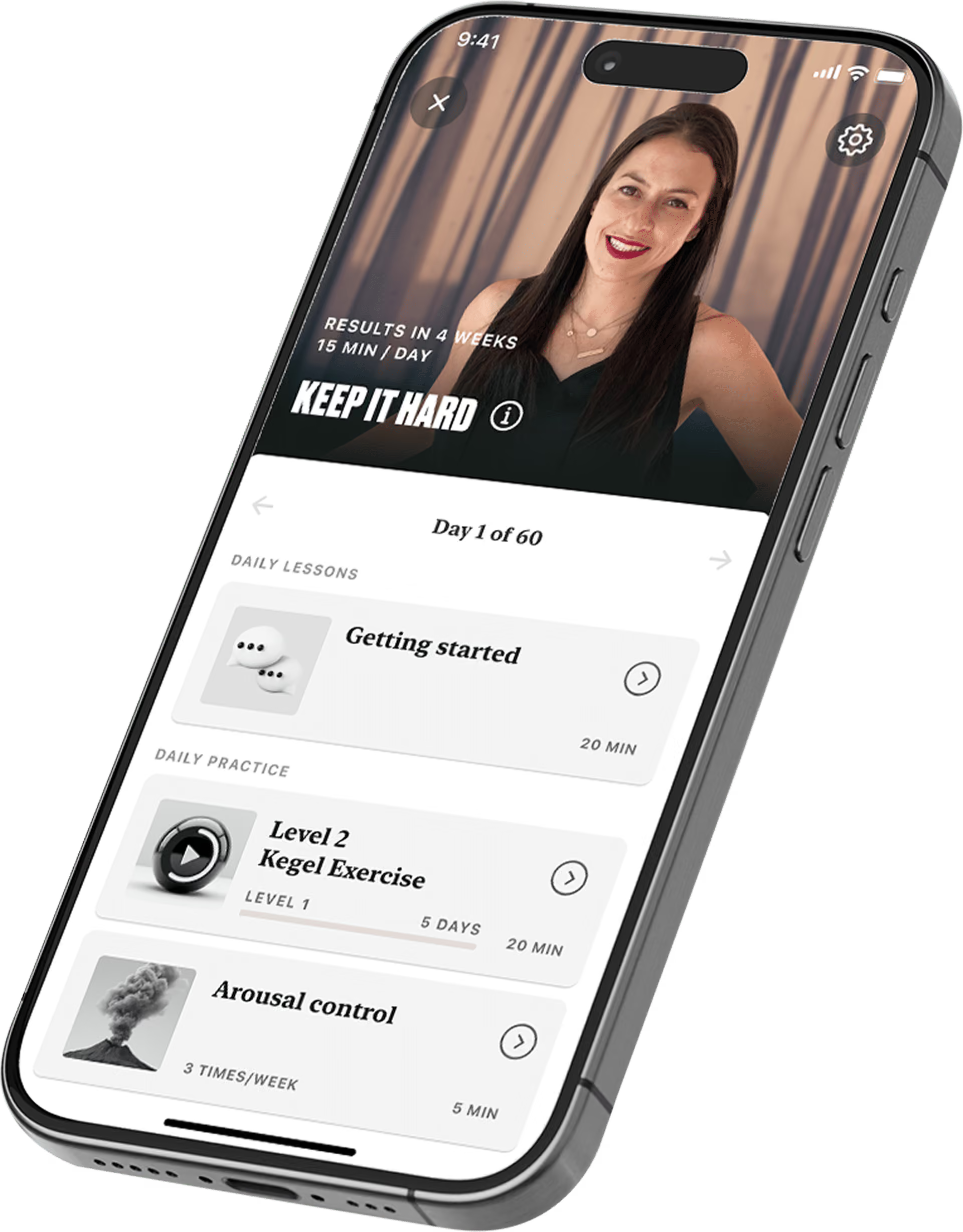
Last Longer is an 8-week program in The Coach app. It goes from basic awareness of your arousal to control during sex, solo first and then with a partner.
The goals run from spotting the early signs of arousal in week 1 to staying in control with a partner in the final weeks.
Lessons lead into daily sessions: guided breathing, muscle relaxation and solo arousal practice.
A 6-week Kegel program with reminders and daily guided audio sessions builds the pelvic floor strength you need when you’re close to orgasm.
You may be starting with your first solo sessions, or you may already stop in time and want to learn to hold a level. Answer a few questions and your plan starts from where you are.
It works through repetition: a single pause only delays ejaculation once. What changes with weeks of practice is that you notice your level earlier and learn which muscles to relax and how to breathe to bring it down. It has been taught since the 1950s and is still one of the standard behavioral exercises for premature ejaculation.
It also has limits. On its own it depends on stopping, and stopping in the middle of sex isn’t always what you or your partner want. It doesn’t strengthen your pelvic floor muscles either, and a strong pelvic floor is what helps when you’re already close to the point of no return. And it takes regular practice, not a few attempts.
Practice doesn’t replace a medical check. See a doctor if you almost always ejaculate within about a minute and this has gone on for six months or more, if the problem appeared suddenly, or if it comes with pain or trouble getting an erection.
For the pelvic floor part of the training, start with our guide to Kegel exercises for men.
During sex you rarely need a full stop. When arousal jumps, cut your speed by half or pause for 5 to 10 seconds, switch to shallow or circular movement, and breathe out slowly. Easing back so that the contact is less direct also buys you time without ending the moment.
Arousal often jumps when you change position. Take a full breath before you move, breathe out as you switch, and begin in a less intense position such as spooning.
Check your level as you go, and act at 7 or 8 instead of waiting for 9. Keep the muscles around your pelvis relaxed. It also helps to tell your partner what the pauses are for.
Staying close to orgasm on purpose, without going over, is a practice of its own: see what edging is and how to do it.
The Coach asked users about their results after their first four weeks in the app.
Stop-start only helps if you do it regularly. In Last Longer a session is prepared for each day, so you don’t have to work out what to do next. The quiz asks a few questions and gives you a plan to start from.
Reviews from men who use The Coach app.
“I was skeptical on how the exercises would help. I had tried pills to go longer and they had no impact. The exercises and practices in my path have been great to enable my body to learn how to control itself in the moment. Highly recommend as an alternative!”
“Have been taking these Kegel Exercises for a good three weeks. Superb results from this and the arousal control advice. Intercourse with my wife has gone from about 30 secs to 2 mins. Big thumbs up 👍”
“55 yo. After months of being dubious about this app and what it promises, I took a chance on it based on the reviews. Am I ever glad I did! In just two weeks I’ve gone from ‘goodness you finished already? 🥲’ to ‘please finish baby I’m exhausted 🥵’ 🤣👍🏼”
“I have known all these exercises for a while but I was not able to stay consistent for a long time. I like that the app is engaging and makes you keep coming back to do your workouts. I also like that includes breathing exercises and psychological aspects as well. So it is all in one.”
The Coach programs are created with clinical researchers, certified sex therapists and medical professionals, including practicing urologists.
Dr. Justin Houman
MD, UCLA-trained urologist and male reproductive specialist focusing on sexual health.
Dr. Susie Gronski
Licensed physical therapist, certified sexuality counselor, and founder of a men's pelvic health clinic.
Cameron Fraser
Australia's leading men's sex coach, specializing in male sexual wellness and performance.
Dr. Amy Pearlman
Board-certified urologist specializing in male sexual wellness, performance, and hormonal health.
Gerard Greene
Specialist men's health physiotherapist and senior lecturer at Coventry University.
Natalie Goldberg
Certified sex and family therapist dedicated to improving intimate relationships and personal well-being.
Dr. Paula Hall
Accredited sexual and relationship psychotherapist, registered with leading professional bodies in psychotherapy.
Dr. Justin Lehmiller
PhD in social psychology and senior research fellow at the Kinsey Institute.
It’s another name for the stop-start technique. Stop-and-go, stop-start and start-stop all describe one exercise: you build arousal, pause before you get too close to orgasm, wait for the arousal to fall, and start again.
The Semans technique is the original version of the stop-start method. It’s named after James Semans, the urologist who described it in 1956. In his version it was the partner who stimulated the man and stopped at his signal.
Three times a week for two weeks, on your own first. Each session is 5 to 10 rounds and takes about 20 minutes. Partner practice follows the same schedule, with sessions of at least 20 minutes.
It depends on the man. The exercise itself is planned for two weeks alone and two weeks with a partner, and it’s one part of a longer course of training. For a change that lasts, allow about two months of regular practice. Some men get there sooner and others need longer.
That can happen when arousal drops very quickly, for example from 8 straight to 2, because your body reads it as the end of sex. It isn’t a failure. Come down in steps, first from 8 to 6, slow your movement without freezing, and make your exhales longer than your inhales. If the erection still fades, breathe, use light touch and continue when it returns.
Nothing is lost. Next time stop one level earlier, and watch for the signs that come before the point of no return: tension in your pelvic floor and legs, short and shallow breathing, and pressure in your lower belly.
Stop-start relies on a pause. The squeeze technique adds pressure: when the urge to ejaculate arrives, you firmly squeeze the head of your penis for about 15 seconds. You can combine them by pausing first and adding the squeeze if the pause alone isn’t enough.
They overlap. In stop-start you move up and down between levels and pause each time. Edging means staying close to orgasm, around level 8 or 9, without going over. Stop-start comes first because it teaches you to recognize those levels.
At the lower levels, slowing down, relaxing and breathing deeply is often enough. Near level 8, take a real pause, easing off rather than stopping dead, and wait until the arousal has clearly fallen.