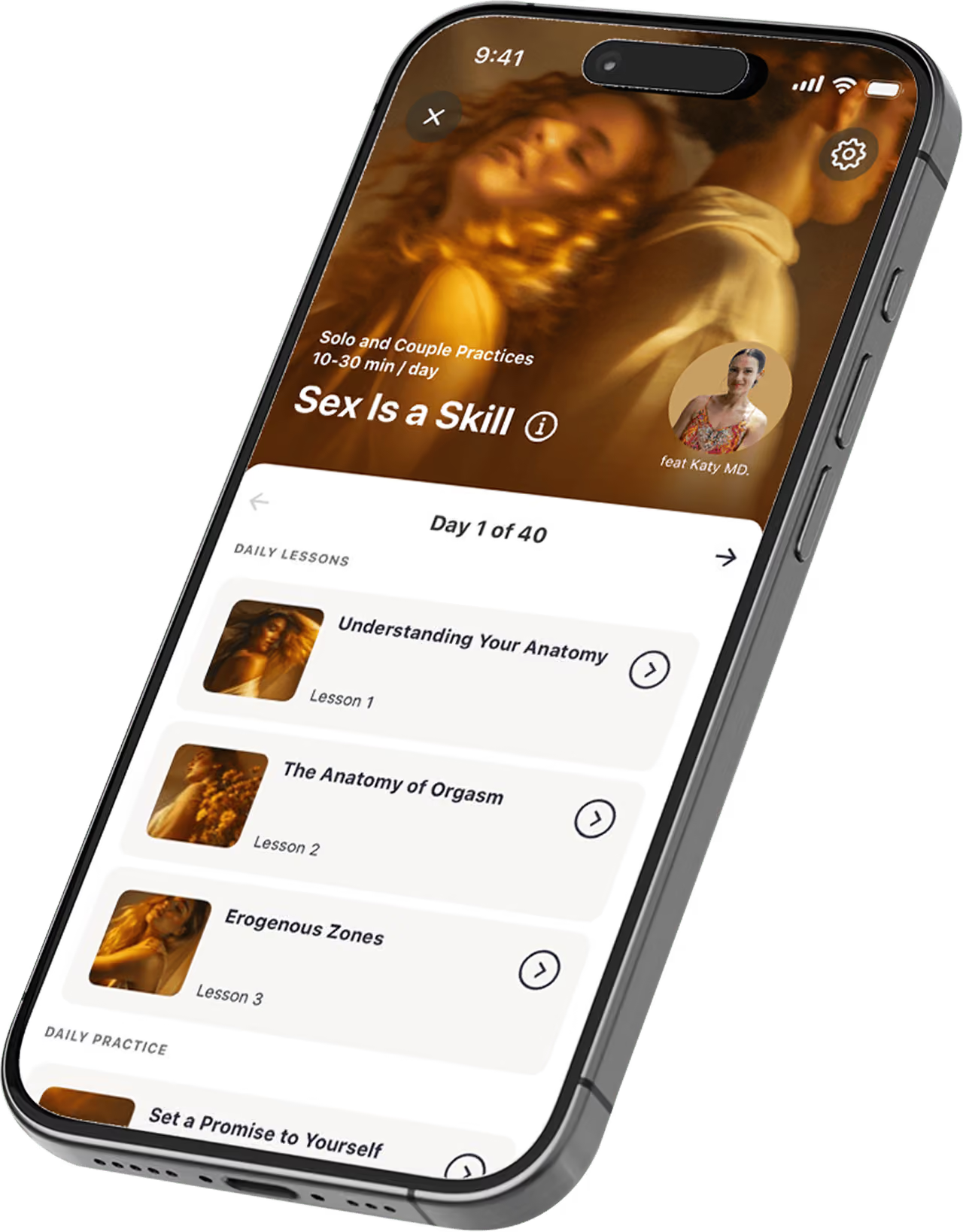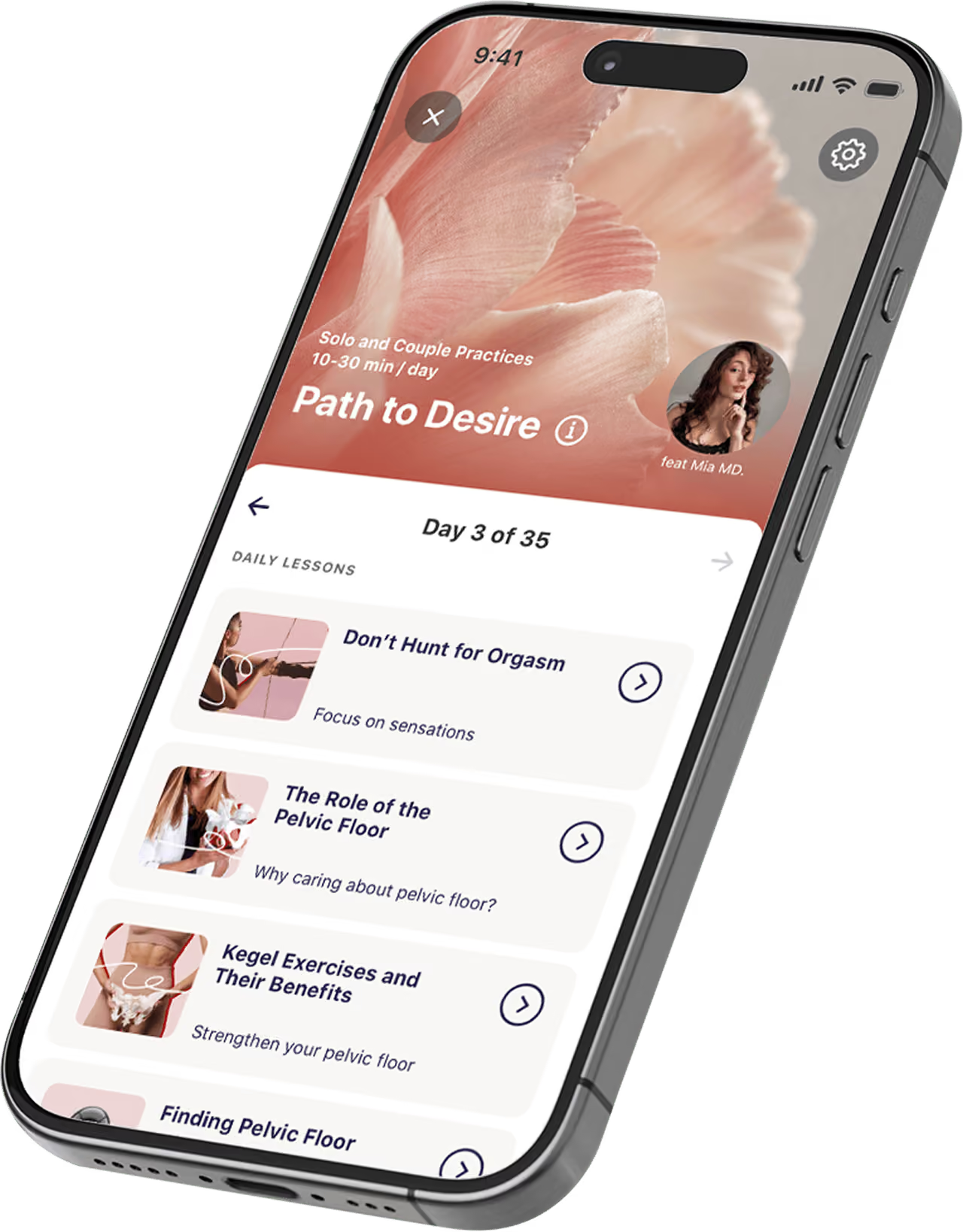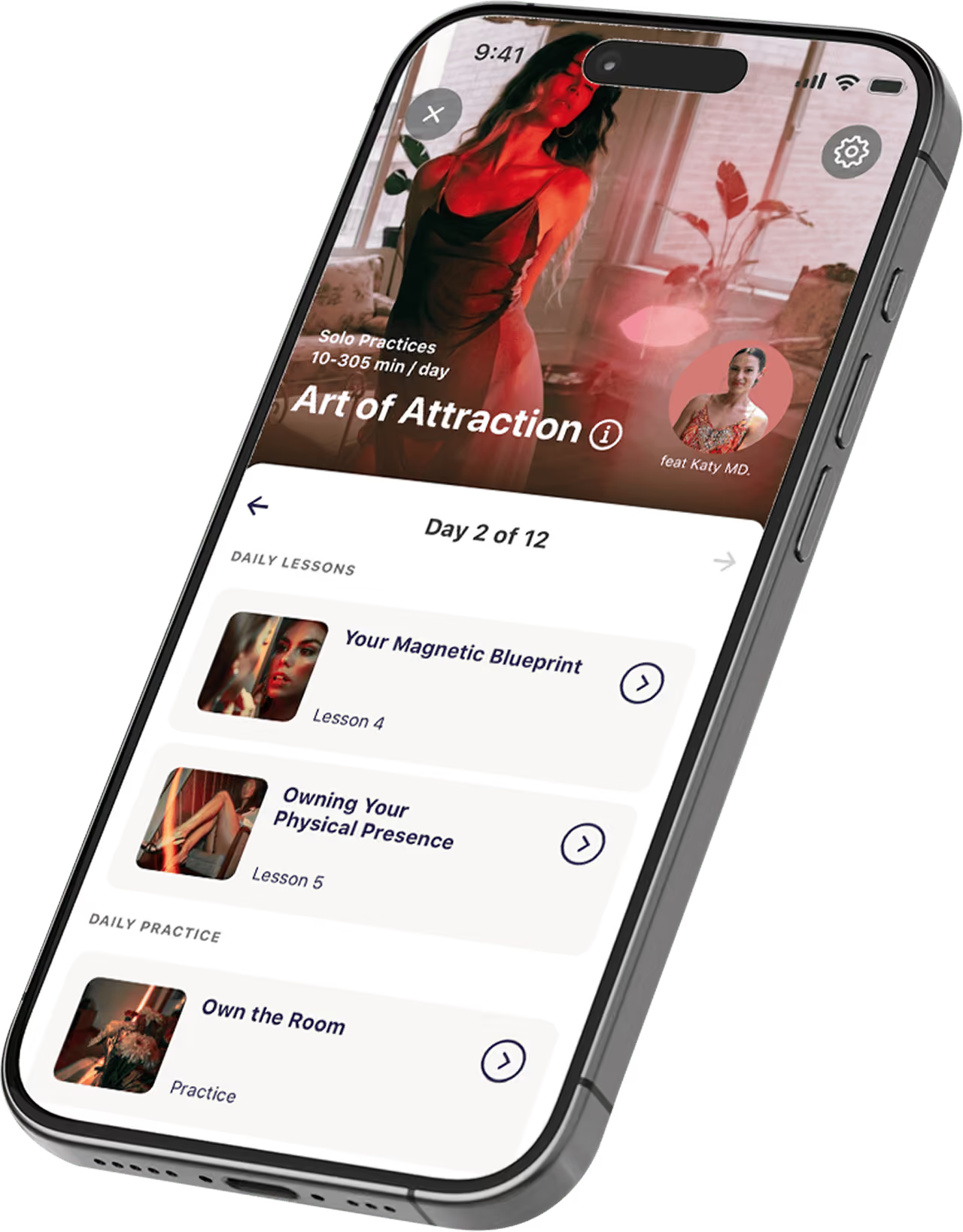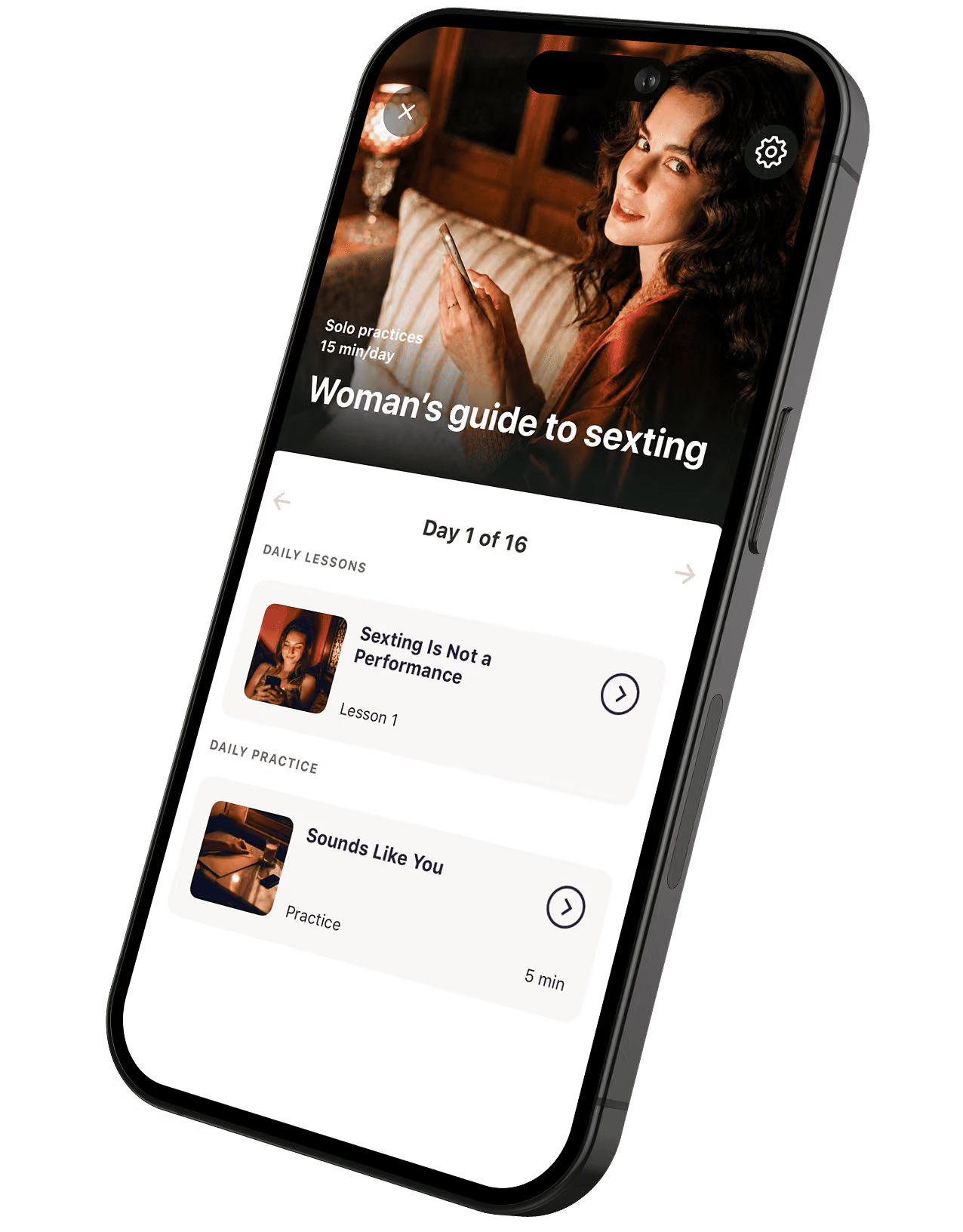
There is no single right way to masturbate, but a handful of techniques work for many women. You can tap, circle or press around the clitoris, touch it indirectly through the clitoral hood or the outer lips, stroke the front wall of the vagina with curved fingers, or use a toy. Each one is described here by what your hand does, so you can try them one at a time. All of them are taught in Sex is a Skill for Her, a program in The Coach for Her app.
Take the quizMost women masturbate by touching the clitoris with their fingers or a vibrator, usually around it rather than directly on its tip. Some add touch inside the vagina once they are aroused. For most women the clitoris is the most direct route to orgasm, so it is the place to start.
The clitoris is larger than it looks. The part you can see is only its tip. The rest lies under the skin, with two legs that run along either side of the vagina, and it swells with blood as you get aroused. That is why touch beside the clitoris can work as well as touch on it, and why a stroke that feels dull or too sharp at the start can feel good once you are aroused.
The techniques fall into four groups: touch on the outside, touch on the inside, toys, and positions that make internal touch easier.
If you’d rather be led through a whole session step by step than choose from a list, that is what guided masturbation is for.
A few masturbation tips for women apply whichever technique you choose, because warm-up, lube, time and pressure change how any touch feels.
The breasts and nipples respond to touch as well, and for some women that touch leads to orgasm; our guide to nipple orgasm explains how.
The first three press or stroke the clitoral hood or the skin beside it. The other four soften the contact on purpose: you glide over the hood or move it, squeeze the outer lips around the clitoris, or touch through fabric. That helps whenever direct touch feels like too much, which is common early on and right after an orgasm.
The sensitive area inside the vagina is the G-region, often called the G-spot. It sits on the front wall, the side toward your belly, about two to three inches in, and it can feel slightly ridged or spongy. Its exact location varies from woman to woman.
The G-region responds only when you are already aroused, so begin with external touch and keep it going. The first sensation may be pressure, or a feeling that you need to pee. That is normal, and it tends to turn into pleasure as arousal builds. If you feel nothing, come back to it later in the session or on another day. Stop if anything hurts, and see a doctor about pain that keeps coming back.
None of this has to work the first time. Internal pleasure is learned through repetition, and it helps to try the techniques in a sensible order. Sex is a Skill for Her teaches them through lessons and practices. Answer a few questions and you get a plan to follow.
Every technique is a movement you can learn, and you decide which ones to keep.
The first part of the program is about your own pleasure, and that is where most of these techniques are taught.
Clitoral touch, indirect touch and G-region touch each have their own lesson. The anatomy comes first and the techniques follow.
In each practice session you try the techniques at your own pace. Sessions take between ten and thirty-five minutes.
The lessons also explain how arousal builds, what to do when touch feels too sharp or too dull, and how to use a technique during sex with a partner.
You don’t need to try every technique at once. Take the quiz, and your plan will give you a place to begin.
A toy is optional, and none comes with the app: you would buy it yourself. Three kinds are worth knowing, and each has its own technique.
Deeper on the same wall lies the A-spot, which a longer curved toy can reach. It needs its own preparation, and our guide to cervical orgasm covers it too.
Position matters most for internal touch, because it changes the angle at which your fingers or a toy meet the front wall. For external touch, choose any position in which your hand and wrist can stay relaxed.
The Coach asked its users what had changed after their first four weeks in the app. The figures describe what they reported, not what any one person should expect.
A technique you have tried once is not yet familiar. It becomes familiar when you come back to it on another day and repeat the same movement. The program puts the lessons and practices in order, and the quiz is where that order starts.
Women who use The Coach for Her describe it in their own words.
“The programs are super easy to follow and have taught me so much about my own body! Definitely recommend”
“Friendly daily practices that gently and compassionately bring you closer to your sensual self”
“I am super impressed with how well explained is everything, the practices are soft, relaxed, nothing is pushed or forced. Honestly is a lot more than I expected ❤️”
“Very approachable. I hadn’t ever used an app like this but I feel like it has given me perspective about my own body and has enhanced intimacy. Educational and engaging, I am enjoying it.”
The Coach develops its programs with clinical researchers, certified sex therapists and medical professionals.
Dr. Jessica Yih
Urologist and director of women's sexual health and male infertility at UCI.
Dr. Kirti S. Patel
Board-certified ob/gyn and host of The Gynarchy, a women's-health podcast.
Dr. Justin Lehmiller
PhD in social psychology and senior research fellow at the Kinsey Institute.
Dr. Paula Hall
Accredited sexual and relationship psychotherapist, registered with leading professional bodies in psychotherapy.
Natalie Goldberg
Certified sex and family therapist dedicated to improving intimate relationships and personal well-being.
Dr. Susie Gronski
Licensed physical therapist, certified sexuality counselor, and founder of a men's pelvic health clinic.
Dr. Gary Shlifer
DO, board-certified internal medicine physician specializing in preventative care, nutrition, and anti-aging.
Dr. Joshua Roland
MD, sleep medicine specialist, and clinical instructor at the David Geffen School of Medicine, UCLA.
On the outside. Warm up, use lube, and begin with light tapping on the clitoral hood, then slow circles. Leave internal touch and toys for later sessions, once you know what pressure and rhythm you like.
There isn’t one best technique, because bodies differ. For most women the clitoris is the most direct route to orgasm, so the external techniques are the usual place to begin. Try them one at a time and keep the ones that feel good.
Warm up for longer and add lube. Numbness usually means that you aren’t aroused enough yet. An air-pulse toy can also help a clitoris that is slow to respond. If touch hurts, or if you have felt nothing for a long time, talk to a doctor.
No. Every finger technique works without one. A vibrator or an air-pulse toy can help if the clitoris is slow to respond. You would buy it yourself, because no toy comes with the app.
Yes. The G-region responds only when you are already aroused, and for some women only after a first orgasm. Internal pleasure is something you learn through repetition, so it may take several sessions.
Not by themselves. Squirting builds on front-wall touch at high arousal and has a method of its own, which our guide on how to squirt covers.
Switch to indirect touch. Glide over the hood without moving the skin, squeeze the outer lips together, or touch yourself through fabric. You can also simply stop.
A water-based lube works for touch inside the vagina and with every toy. A silicone-based one lasts longer, but it shouldn’t be used with silicone toys.
Yes. Place your hand over your partner’s to show the rhythm and pressure you like. During penetration, you or your partner can keep a hand on your clitoris, because many women need that touch to reach orgasm.
It teaches the techniques in lessons and in practice sessions of ten to thirty-five minutes. It also explains how arousal builds and how to use the techniques with a partner. You start with a short quiz and get a plan.