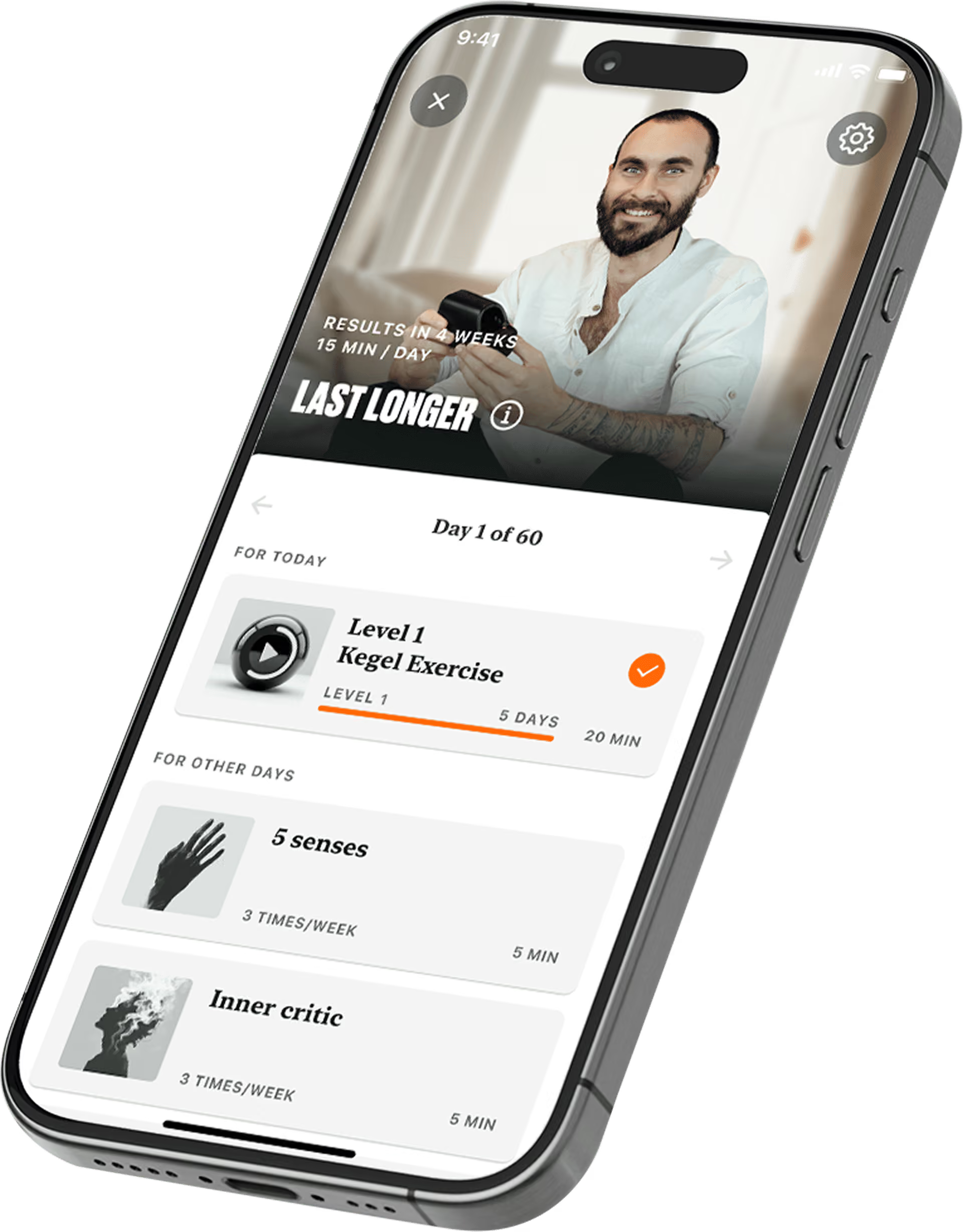
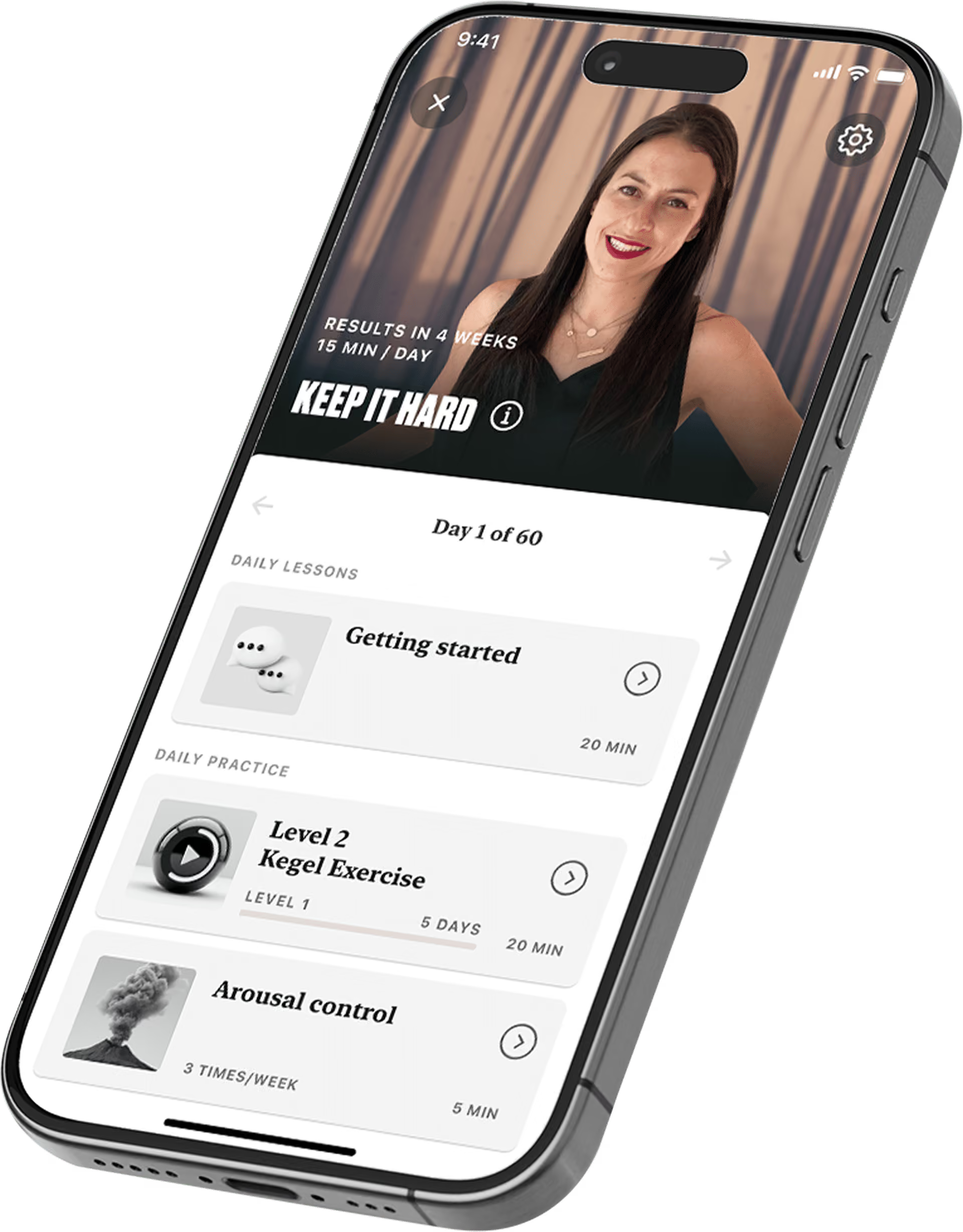
To masturbate longer, slow your hand down, loosen your grip, breathe out slowly, and ease off well before you feel close to orgasm. When your arousal has dropped, build it up again and repeat. A session done this way takes about twenty minutes, and it teaches your body to stay aroused without rushing to the finish. Last Longer, a program for men in The Coach app, begins with this kind of solo practice.
Get my planHow long you last depends a lot on your speed, your grip, your breathing and how tense your body is. Start with these six changes.
These six changes can make masturbation last longer the first time you try them. To masturbate for a long time and stay in control throughout, use them inside a structured practice: stop-start first, then plateauing.
Both techniques use a scale of arousal from 1 to 10. At 1 and 2 you aren’t aroused at all. At 5 and 6 you’re clearly aroused but still feel in control. At 7 and 8 your arousal is high and it’s hard to think about anything else. Level 9 is the point of no return, when orgasm feels inevitable, and 10 is orgasm.
In stop-start you raise your arousal to a level you choose and then bring it back down. In plateauing you hold one level steady. Begin with stop-start.
When these sessions feel easy, the next step is staying just under 9 for longer, which our guide to what edging is and how to do it explains.
There is no reliable average masturbation time. Sex with a partner has been timed in studies, but masturbation hasn’t been measured the same way, so any figure you see for it is a guess.
How long it takes to masturbate depends on what you’re doing. A hurried session is short because finishing fast is the point. A stop-start session takes about twenty minutes, because you bring your arousal down several times along the way.
A more useful measure than minutes is whether you finished when you decided to. Practice is working when you can hold your arousal at a level you chose and come down from it, whatever the clock says.
For sex with a partner there are measured figures, and you’ll find them in our guide to how long sex should last. Last Longer builds a plan from your answers to a few questions, so your first sessions match your experience.
Finishing quickly on your own is often a learned pattern, and a pattern can be retrained. Here are six common reasons.
These sessions also prepare you for sex with a partner, because the skills carry over: knowing your arousal level, breathing slowly, keeping your muscles relaxed and easing off in time. Masturbation training comes first because on your own you can experiment and feel what’s happening without any pressure.
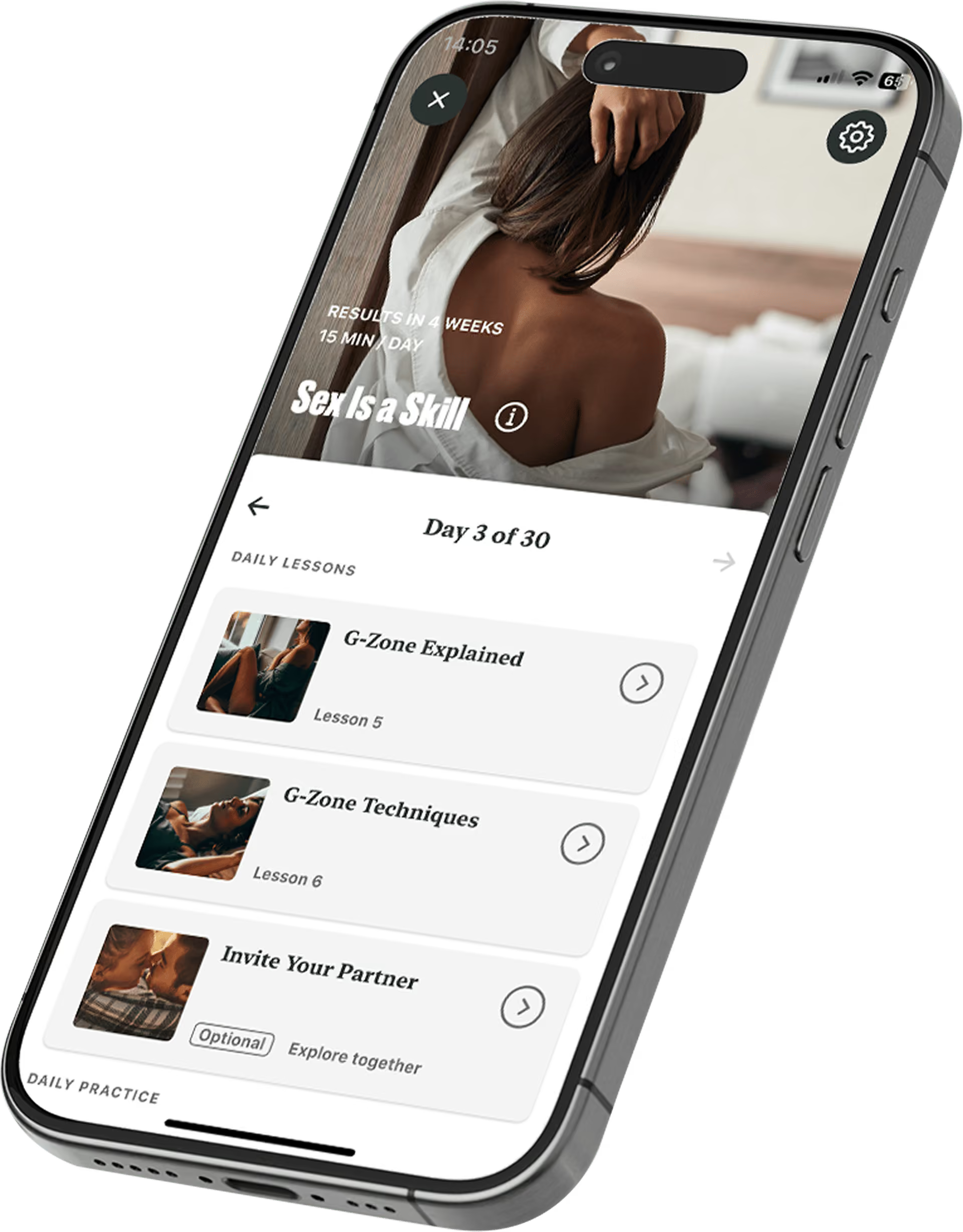
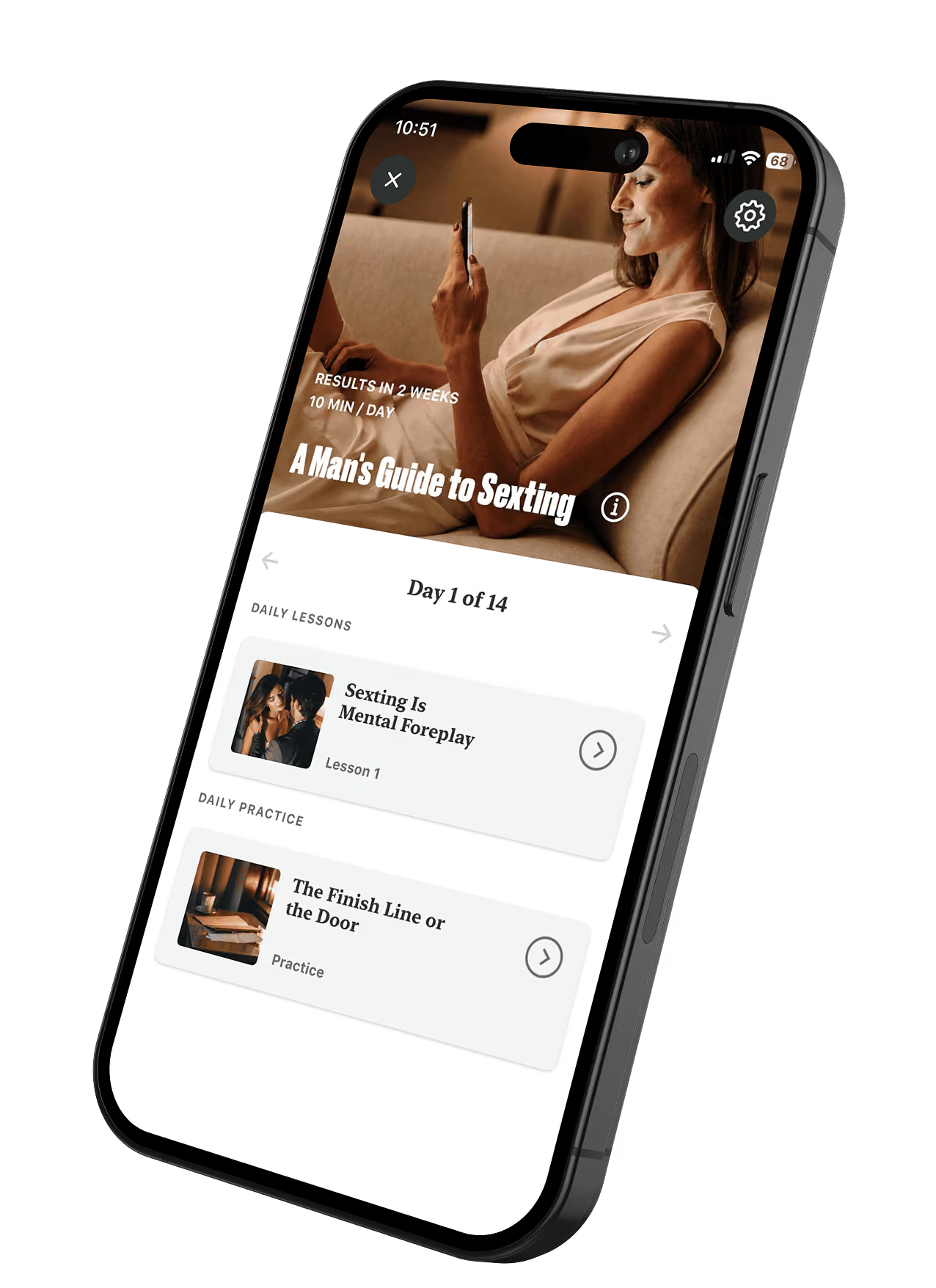
Last Longer sets out this training step by step. The program runs for eight weeks, starts with solo practice and moves on to practice with a partner, and each day’s plan includes a guided session. Your answers to a few questions decide where your plan starts.
The way you masturbate is practice for the way you have sex.
Practice is easier to keep up when each session has a clear task. Last Longer sets that task for every session.
Each day’s plan tells you what to practice, so you don’t have to design the sessions yourself.
In these solo sessions you stimulate yourself slowly and deliberately, track your arousal on the 1-to-10 scale and bring it down with your breath and relaxation.
Guided breathing and muscle relaxation teach you to calm your body, and you use that skill in practice and during sex.
Answer a few questions about yourself and your goal, and you’ll get a personal plan that starts at your level.
Lasting longer alone doesn’t carry over to sex automatically. With a partner there is more excitement, less predictability and sometimes worry about finishing too soon, and worry tightens your body and speeds everything up.
That is normal, and it’s the reason practice with a partner is a stage of its own. One habit from your solo sessions is worth bringing into sex before anything else: a long, slow exhale whenever you feel your arousal rise.
The full sequence, from solo sessions to sex, is in our guide on how to train yourself to last longer in bed.
Three mistakes slow practice down. The first is rushing ahead: moving on to plateauing or to partner practice before stop-start feels easy. The second is squeezing your pelvic floor the whole time, which builds tension, so keep it relaxed. The third is stopping as soon as you see results, while the skill still needs regular practice.
Practice like this changes habits, and some problems are not habits. See a doctor if ejaculation is painful, if you notice blood in your semen, if finishing fast started suddenly, or if you also have trouble getting or keeping an erection.
The Coach surveyed its users after their first four weeks. These figures show what they reported, and your own results may differ.
You can run these sessions yourself. If you’d rather have each one laid out for you, with breathing, relaxation and Kegel training alongside, take the quiz and get a plan built around your answers.
Reviews from men who practiced with the program, in their own words.
“55 yo. After months of being dubious about this app and what it promises, I took a chance on it based on the reviews. Am I ever glad I did! In just two weeks I’ve gone from ‘goodness you finished already? 🥲’ to ‘please finish baby I’m exhausted 🥵’ 🤣👍🏼”
“Have been taking these Kegel Exercises for a good three weeks. Superb results from this and the arousal control advice. Intercourse with my wife has gone from about 30 secs to 2 mins. Big thumbs up 👍”
“I have known all these exercises for a while but I was not able to stay consistent for a long time. I like that the app is engaging and makes you keep coming back to do your workouts. I also like that includes breathing exercises and psychological aspects as well. So it is all in one.”
“I was skeptical on how the exercises would help. I had tried pills to go longer and they had no impact. The exercises and practices in my path have been great to enable my body to learn how to control itself in the moment. Highly recommend as an alternative!”
The Coach programs are developed with clinical researchers, certified sex therapists and medical professionals, including practicing urologists.
Dr. Justin Houman
MD, UCLA-trained urologist and male reproductive specialist focusing on sexual health.
Dr. Susie Gronski
Licensed physical therapist, certified sexuality counselor, and founder of a men's pelvic health clinic.
Cameron Fraser
Australia's leading men's sex coach, specializing in male sexual wellness and performance.
Dr. Amy Pearlman
Board-certified urologist specializing in male sexual wellness, performance, and hormonal health.
Gerard Greene
Specialist men's health physiotherapist and senior lecturer at Coventry University.
Natalie Goldberg
Certified sex and family therapist dedicated to improving intimate relationships and personal well-being.
Dr. Paula Hall
Accredited sexual and relationship psychotherapist, registered with leading professional bodies in psychotherapy.
Dr. Justin Lehmiller
PhD in social psychology and senior research fellow at the Kinsey Institute.
Masturbation itself doesn’t. A rushed habit can: if you always finish as fast as possible, your body learns to climax quickly, and it tends to follow the same pattern with a partner. Slow, deliberate practice trains the opposite.
Common reasons are a fast rhythm, a lot of pressure and intense porn. Tension in the abs, thighs or pelvic floor plays a part too, and so does never having practiced holding your arousal at one level. Some men are also very responsive to stimulation, and that doesn’t mean something is wrong. In either case the practice is the same: slow down, lighten your grip and bring your arousal down before it peaks.
Three sessions a week of about twenty minutes each: two weeks of stop-start, then two weeks of plateauing. That is a practice schedule, and how soon you notice a change varies from man to man.
It’s not a problem. Next time go more slowly and pay closer attention to the signs that come just before orgasm, such as tightening muscles and short, shallow breathing. Learning to spot those signs earlier is the purpose of the exercise.
Masturbating one to two hours before sex can reduce sensitivity for that occasion. It’s a short-term aid and doesn’t train control, so use it alongside practice and not as a replacement for it.
Yes, as one part of the training. With a strong pelvic floor you can hold back with a brief, firm squeeze right before the point of no return, and that strength is built with regular Kegel practice over six weeks or more. For the rest of a session, keep those muscles relaxed.
It’s better not to. With porn you can get used to being aroused by what you see, and it becomes harder to keep your attention on your own arousal level, which is the thing you’re training.