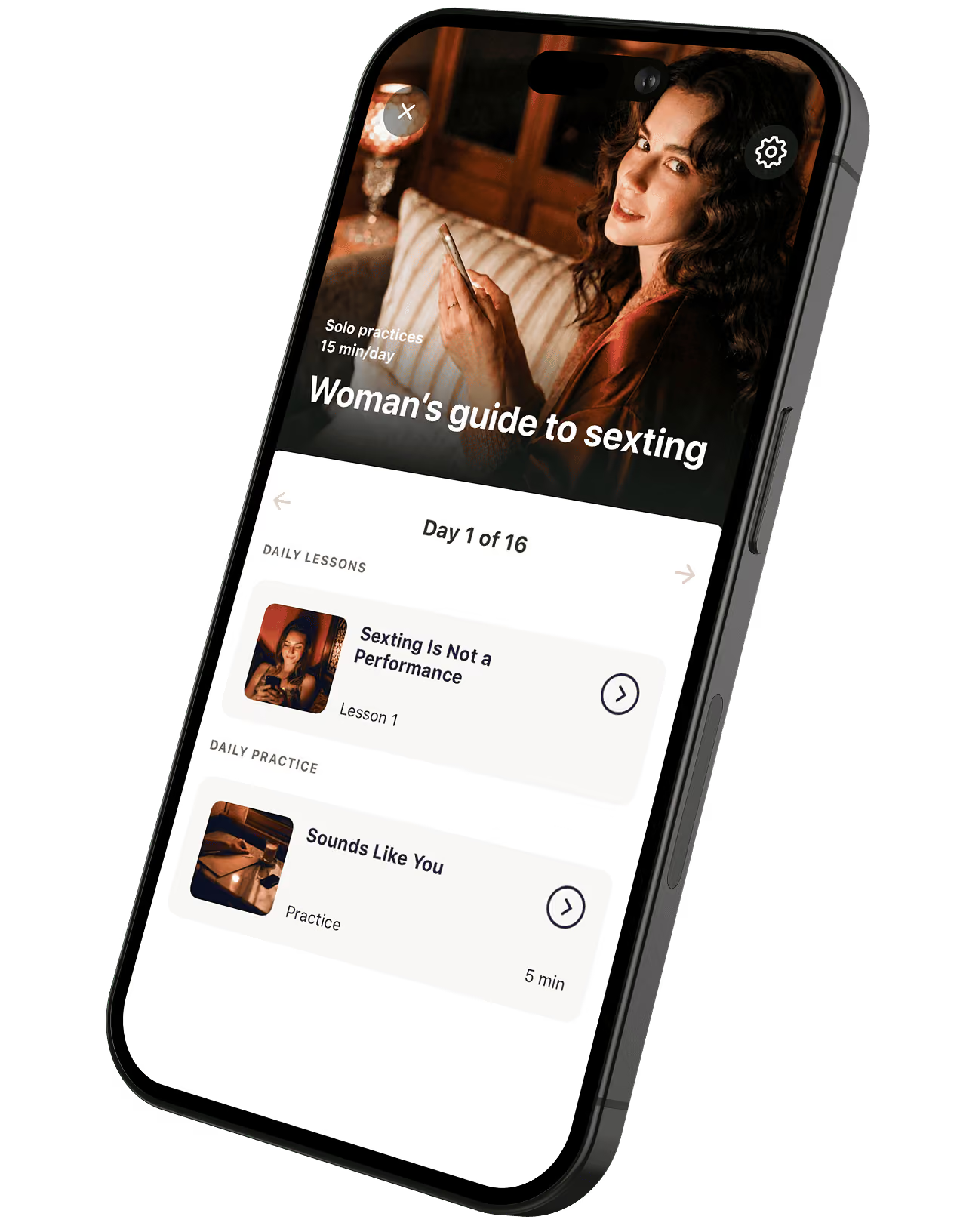
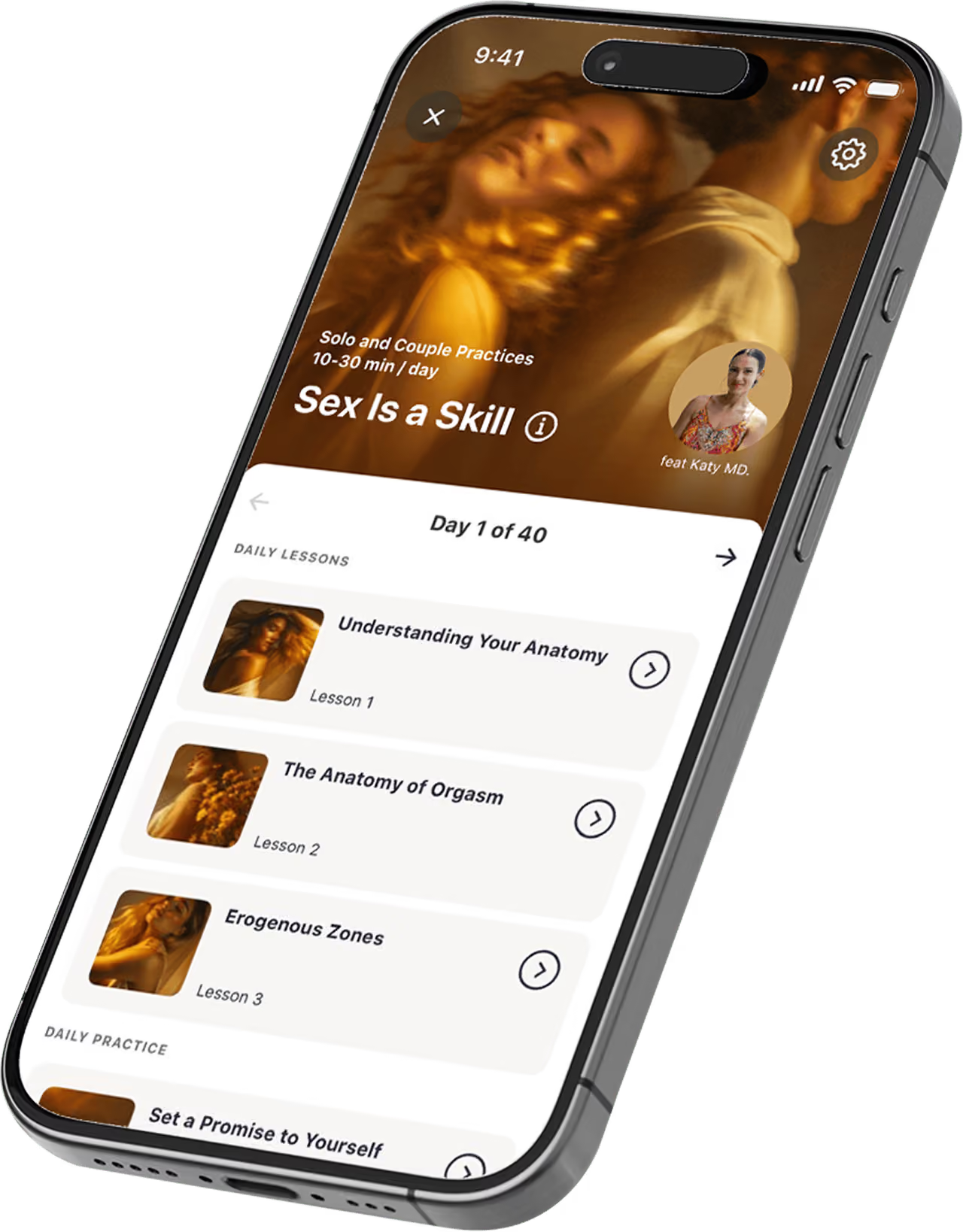
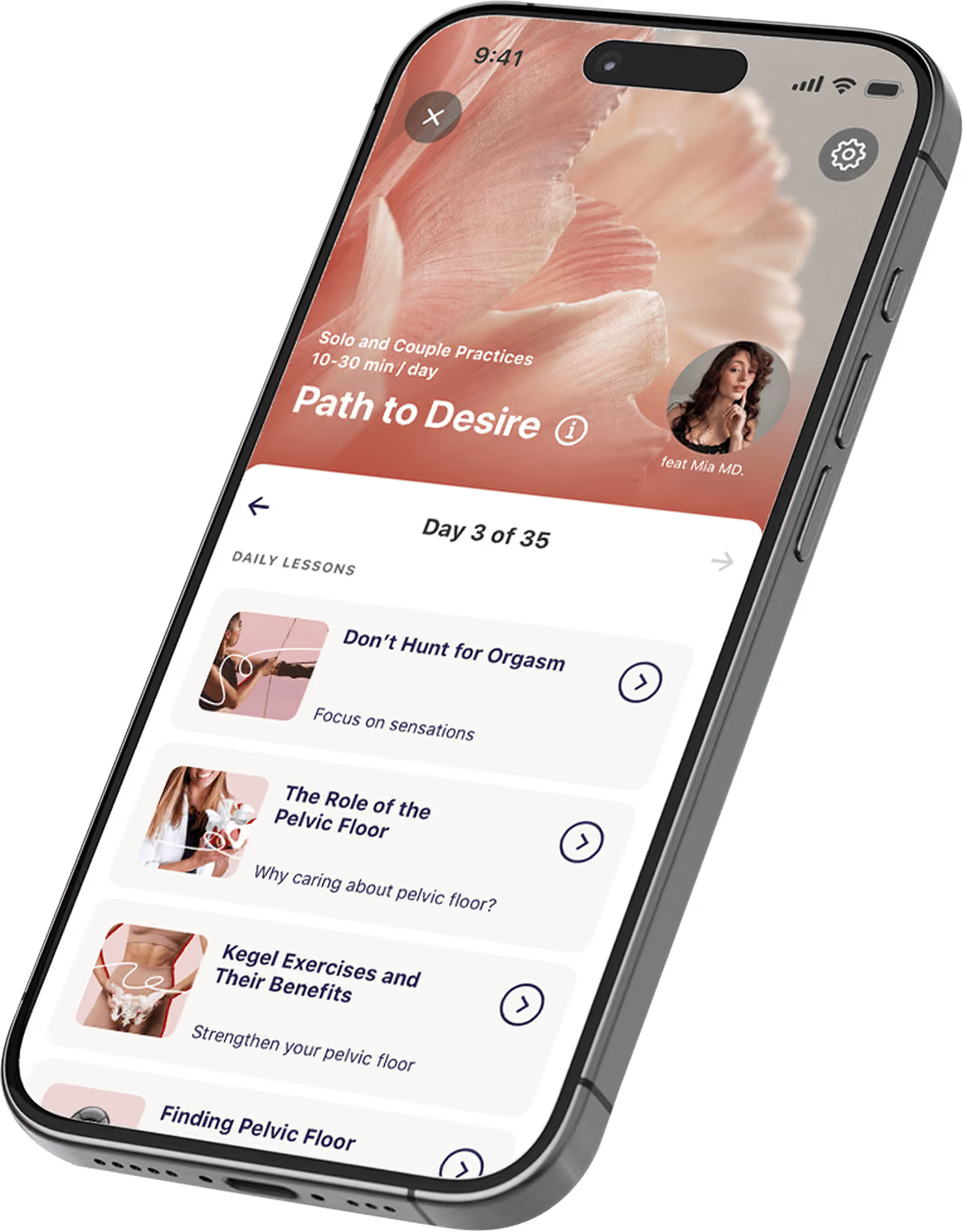
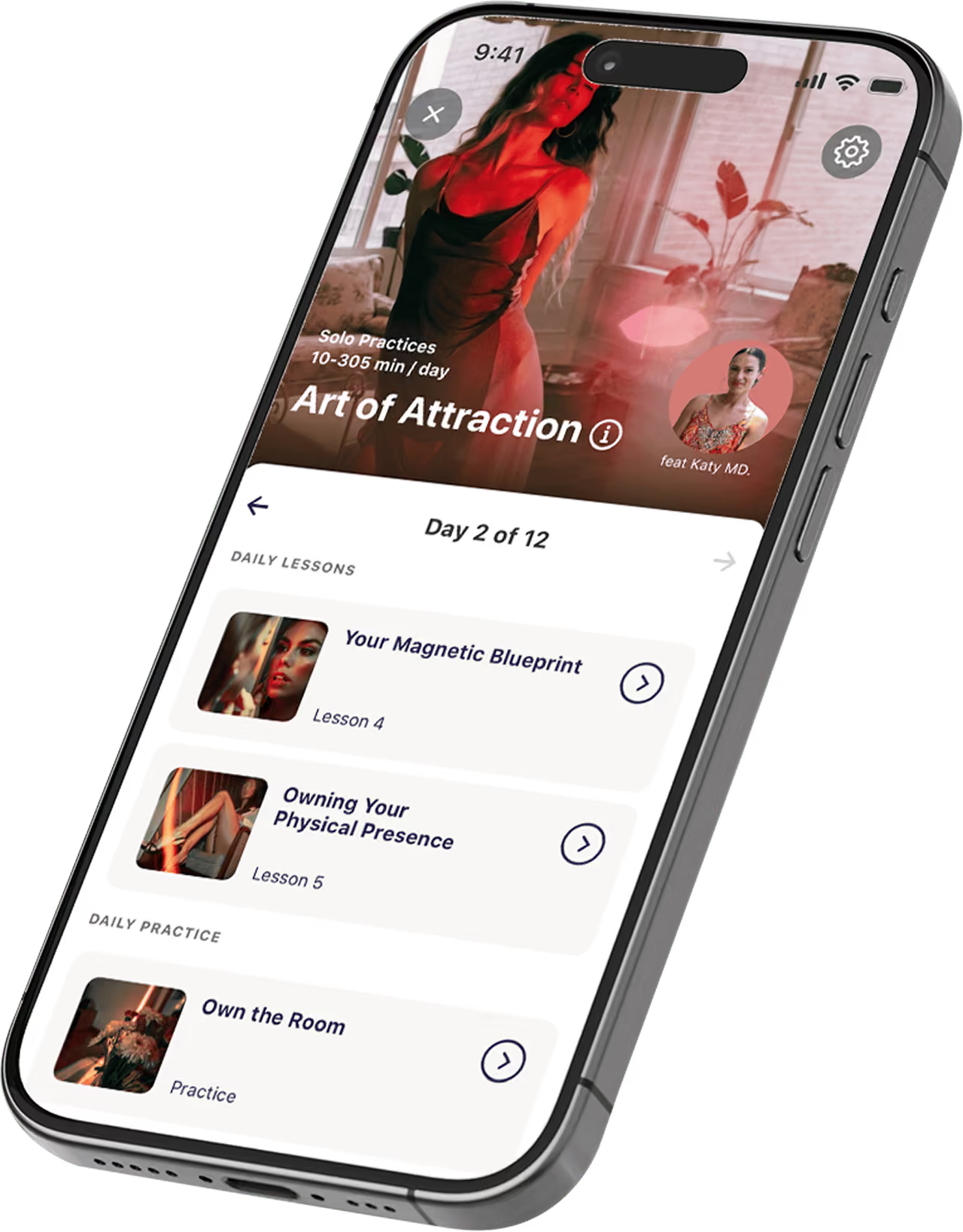
Sexting means sending flirty or sexual messages to someone you’re attracted to, and doing it well has less to do with dirty words than with sounding like yourself. Start with a small, true message: that you noticed him, that something he did stayed with you or that you want him closer. Then let the conversation build one step at a time, at a pace that feels comfortable. Photos are optional, and you can stop whenever you want. Woman’s Guide to Sexting, a program in The Coach for Her app, teaches this in 16 lessons, starting with a personal plan.
Get my planMany women feel desire and still freeze when it’s time to put it into a message. That’s common, and it usually says more about the format than about how much you want him.
If you’d rather make the first move in person, our guide on how to initiate sex has ideas for that.
A good sext depends less on finding the perfect line than on a few principles. These four matter most.
Sexting gets easier with practice. These steps work whether you’ve just started dating someone or you’re texting your husband.
You don’t need all six in one conversation. Often the first two are enough to get something started.
If you’d like help with each of these steps, Woman’s Guide to Sexting walks you through them in 16 lessons, from your first small message to carrying the mood into real life. It starts with a personal plan based on your answers to a few questions.
The best sext isn’t the boldest one. It’s the one that sounds like you.
Woman’s Guide to Sexting is a 16-lesson program in The Coach for Her that you read at your own pace. It’s built on the SEXT Method: Safety (your comfort, privacy and control), Emotional Context (reading the moment you’re both in), eXcitement (building desire) and Transition (carrying it into real life).
Six styles, from soft and playful to direct and bold, and a simple test to check whether a message sounds like you.
How to reveal a little, hold back the rest and build tension from one message to the next.
Why photos are optional, how to say no without killing the mood and what to leave out of the frame if you do send one.
A few questions shape a personal plan that shows you where to begin. The lessons start with why sexting can feel awkward and how small messages help, then move on to teasing, fantasy and real life.
How do you start a sext? With something true that reveals a little more than usual. You don’t have to open with anything sexual: tell him you keep replaying something he said, or simply that he’s been on your mind. Lines like “I couldn’t stop thinking about you in that jacket today” or “I had a whole meeting to get through and you kept showing up in my head” are an easy way to initiate sexting without asking much of him or of yourself.
If he replies warmly, add one more piece, such as what you’d like to happen the next time you see him. If he misses the hint, a clear follow-up works better than a bolder line: “I’m flirting with you, in case that wasn’t obvious.” With your husband or a long-term partner, the same openers work, and it can help to say what kind of evening you want, for example “Can we put our phones away early tonight? I’ve missed you.”
If sex has become rare in your relationship, our guide on how to rekindle intimacy looks at ways to feel close again.
Sexting doesn’t have to include photos. Words, a voice note or a hint of what you’re thinking can be enough. If he asks for a picture and you don’t want to send one, you can say no and keep the mood at the same time: “Pictures stay on my phone tonight. Tell me what you’d do instead.” If he keeps pushing after you’ve said no, that’s pressure, not flirting, and you don’t have to explain yourself.
Should you send nudes? Only if you genuinely want to, and only something you’d still be comfortable with if he saved it or the relationship ended. Once an image is sent, it can be screenshotted, backed up or shared, whatever an app promises. If you do decide to send something, a suggestive photo can say plenty without showing everything, and you can leave out your face, tattoos, birthmarks and anything in the background that shows where you are.
To talk with him about what you each enjoy and where your limits are, try our intimacy questions for couples.
From a survey of The Coach users who finished their first four weeks:
Whether you freeze before typing, worry about saying too much or want to keep things playful, you can start with a personal plan based on your answers to a few questions.
Women describe their experience with The Coach for Her in their own words.
“I am still in this journey but i am already feeling more aware and communicating better with my partner.”
“It was great information and has helped in soo many ways! We are closer and more comfortable that ever and I have a ton of confidence.”
“It really helped me learn more about my health and how to improve my intimacy with my husband. I would recommend it”
“It helps me understand myself better, not just emotionally but also in how I connect with others. I like that everything is broken into small, simple lessons, so it doesn’t feel overwhelming.”
The Coach works with clinical researchers, certified sex therapists and medical professionals, among them a urologist and an OB-GYN.
Dr. Jessica Yih
Urologist and director of women's sexual health and male infertility at UCI.
Dr. Kirti S. Patel
Board-certified ob/gyn and host of The Gynarchy, a women's-health podcast.
Dr. Justin Lehmiller
PhD in social psychology and senior research fellow at the Kinsey Institute.
Dr. Paula Hall
Accredited sexual and relationship psychotherapist, registered with leading professional bodies in psychotherapy.
Natalie Goldberg
Certified sex and family therapist dedicated to improving intimate relationships and personal well-being.
Dr. Susie Gronski
Licensed physical therapist, certified sexuality counselor, and founder of a men's pelvic health clinic.
Dr. Gary Shlifer
DO, board-certified internal medicine physician specializing in preventative care, nutrition, and anti-aging.
Dr. Joshua Roland
MD, sleep medicine specialist, and clinical instructor at the David Geffen School of Medicine, UCLA.
Many do, though not every man enjoys the same kind of message. What often affects a man most is feeling wanted: knowing that you thought about him without being asked. Some men respond to direct desire, others to teasing or compliments, so notice what gets his attention and, at a relaxed moment, ask him what kind of message stays on his mind.
Feeling awkward usually means you’re doing something new, not that you’re bad at it. Shy can even be a style of its own: start with short messages that feel safe to send, such as telling him you liked something he did. You can admit you’re nervous, too: “Full disclosure, I’m blushing as I type this” is still flirting.
One clear, kind no is enough, and you don’t owe him an explanation. A partner who enjoys your messages without trying to get more out of them is easier to relax with. If he keeps pushing, step away from the conversation; repeated pressure after a no is a sign to take seriously.
When the attraction is mutual and you feel comfortable with him. There’s no fixed point in dating; it can begin with a light, flirty message after a good date. Early on, keep it suggestive rather than explicit, and let his replies show you whether he wants to go further.
Start with something from your life together: a memory, something he did this week or what you’d like tonight. Messages between long-term partners often become practical, so even one flirty text during the day can change the tone. If you worry that any hint will be read as a promise of sex, say what you’d like the evening to feel like: close and unhurried.
Say so simply, for example “I’m going to stop here, but I liked this.” A flirty message doesn’t create an obligation, and you can stop even if you started. If you need a longer break, tell him the pause is about sexting, not about him, so he doesn’t read your silence as rejection.
No. The lessons work in any relationship: several speak directly to long-term couples, and two include a passage just for early dating, so you can use the program whether you’ve been together for years or have just started seeing someone.