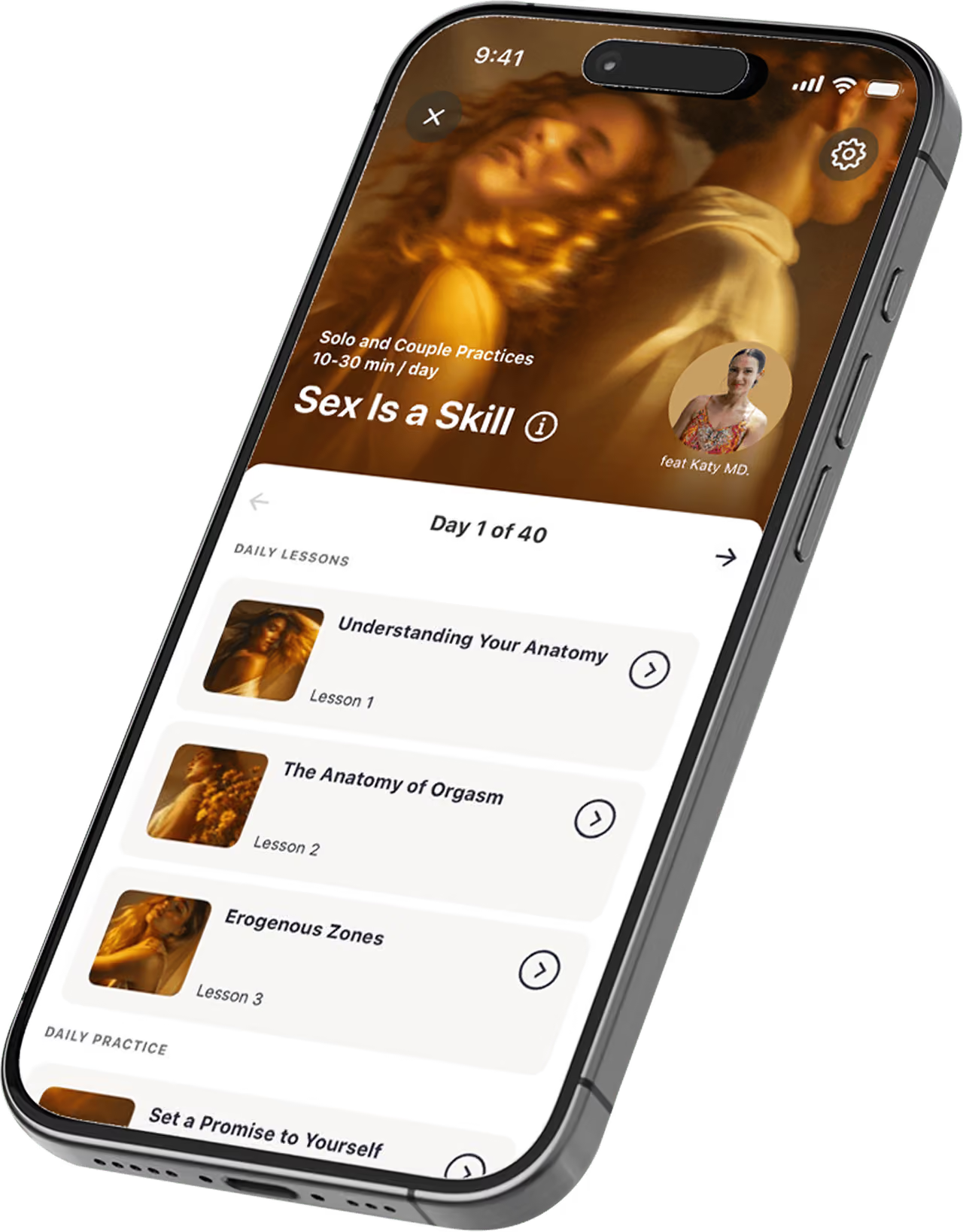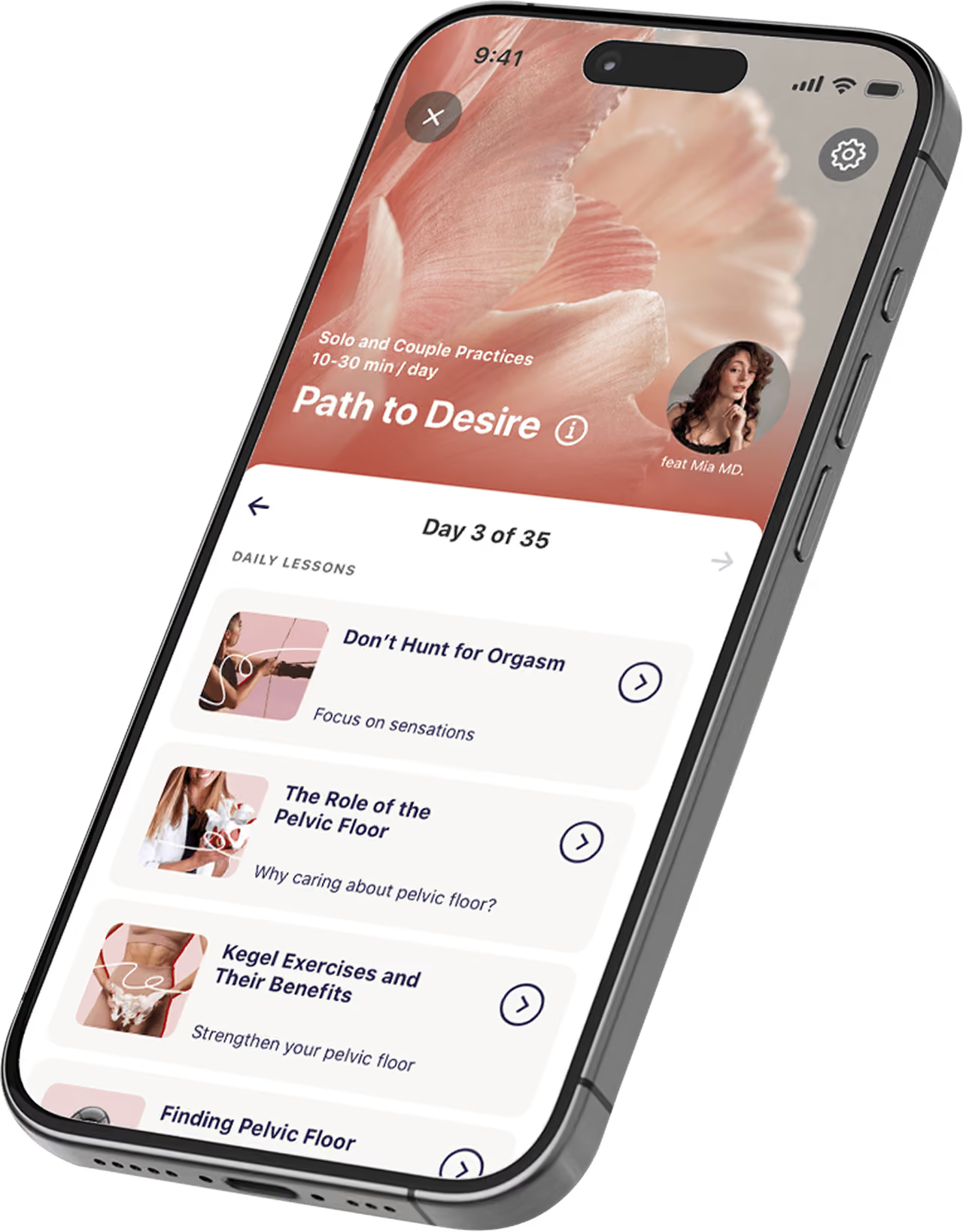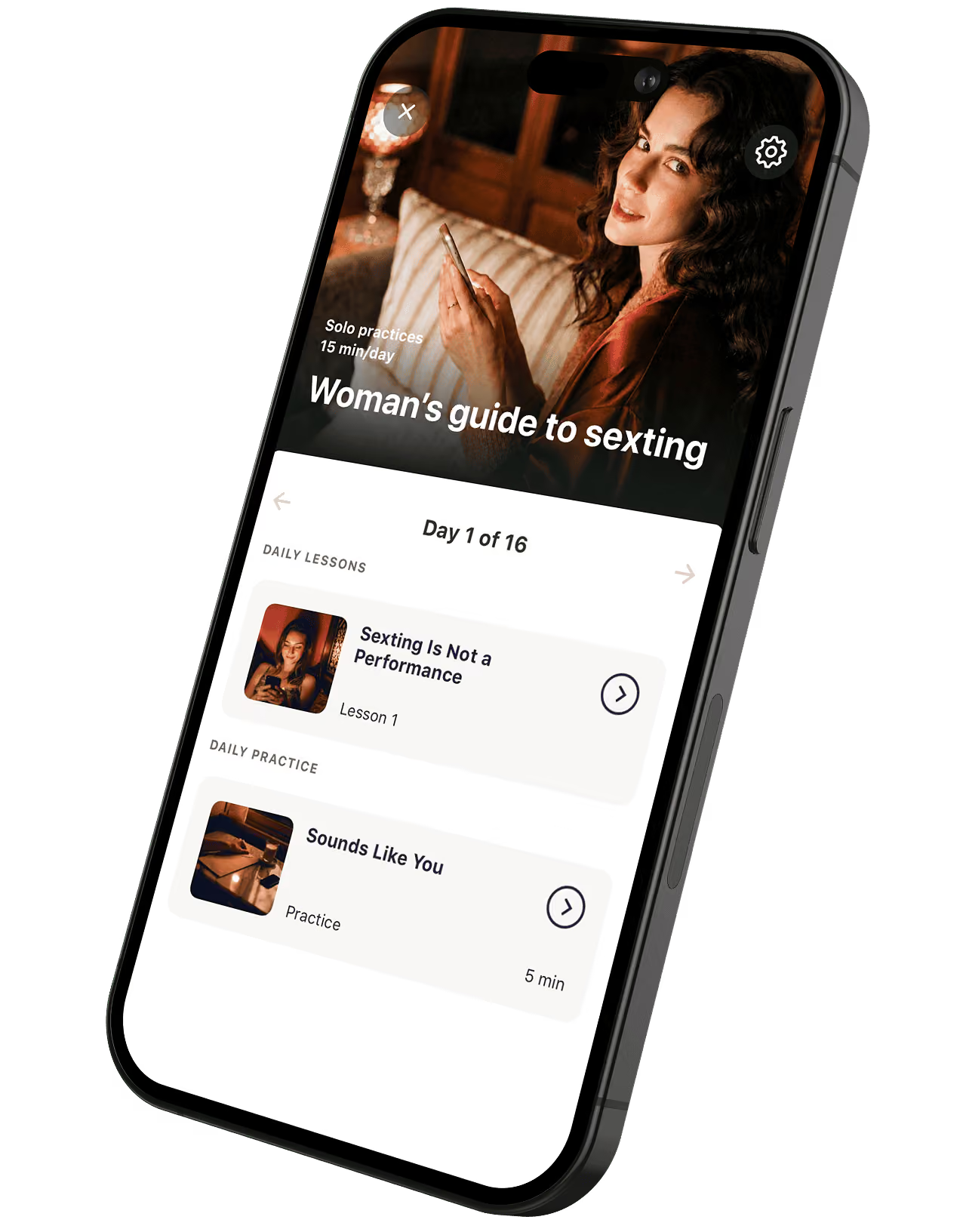
An orgasm is a reflex. You can’t decide to have one, but you can give your body what it needs: enough time to get fully aroused, touch that stays steady as you get close, and a mind that isn’t busy with something else. You can practice all three alone, with your own hand. Sex is a Skill for Her, a program in The Coach for Her app, teaches them through lessons and guided solo practices.
Answer a few questionsYou don’t think your way into an orgasm. Sensation builds until your body crosses a threshold, and then the reflex fires by itself. Three things have to work together for that: your brain, which needs to feel safe and unhurried; your nerves, which carry the signals from touch; and your pelvic floor, the muscles that tighten as you get aroused and contract in waves when you come.
Stress, pressure, too little warm-up and uneven touch can all interrupt the build-up before the reflex starts. Our guide to what an orgasm feels like also covers why an orgasm sometimes doesn’t come.
Female arousal doesn’t switch on like a light. It moves through a sequence of stages, and each one asks for something different.
Wetness comes early, so don’t take it as the signal to speed up. A swollen vulva, deeper breathing and attention that has settled on what you feel are better signs that you’ve reached the plateau.
For many women, the clitoris is where orgasm is easiest to learn. The part you can see is only about a tenth of it; the rest extends inside your body. Keep some lubricant within reach, give yourself time, and try these in order. None of them is a rule; each is a way to find out what your body responds to.
The moment just before orgasm is the easiest one to lose. Pleasure sharpens, your body tenses, and the natural impulse is to speed up, press harder or switch to something stronger. For many women, that change is what makes the orgasm slip away. Whatever your hand was doing when you got close is what your body needs until the orgasm is over: the same spot, the same pressure, the same speed.
Four things tend to break the build-up: changing speed or rhythm, shifting position, adding new stimulation, and stopping to wonder whether you’re about to come. Keeping the touch steady is easier to learn alone, because nobody else can change the rhythm. If you lose it anyway, you haven’t failed. Go back to the touch that was working and let the arousal build again.
Sex is a Skill for Her has a lesson on this moment, and others on arousal, clitoral touch and quieting your mind. Take the quiz and you’ll get a plan built from your answers.
An orgasm can’t be forced, but what leads to it can be learned.
Sex is a Skill for Her is a program in The Coach for Her app. It starts with your own pleasure, before anything that involves a partner.
Lessons explain the orgasm reflex, the stages of arousal, and what speeds arousal up or holds it back, so you can tell what your body needs at each point.
Solo practices take you through touch step by step. One of them, Mindful Masturbation, is about twenty minutes of slow exploration where orgasm isn’t the goal.
A lesson on clitoral orgasm covers the anatomy of the clitoris, why sensitivity differs from woman to woman, and techniques such as Tap-and-Tease and Circular Glides. A guided audio takes you through them.
Answer a few questions and you’ll get a personal plan in The Coach for Her, so you know where to begin instead of guessing.
A mind that is running through a to-do list or checking how long you’re taking keeps your muscles tense and your breath shallow. You can’t switch it off, and you don’t need to, because arousal starts there. What helps is giving your attention somewhere to go.
If staying focused on your own is the hard part, a voice that guides you can hold your attention for you: try guided masturbation.
What you learn alone is what you bring to sex with a partner. Put your hand over his and let him feel the touch you like: circles, broad pressure, touch on the hood instead of the tip. During penetration, many women need clitoral touch to reach orgasm, so keep a hand there, yours or his.
Tell him what happens when you’re close, and say it outside the bedroom: when you go quiet and your body tenses, you’re almost there, and he shouldn’t change anything. In the moment, a few words are enough: “Just like that.” “Don’t stop.” “Keep it steady.”
Reaching orgasm from penetration alone takes its own kind of practice. Our guide to the cervical orgasm has a section on it.
The Coach asked its users what had changed after their first four weeks in the app. The figures describe what they reported, not what any one person should expect.
Pressure works against orgasm. Thoughts like “I should come quickly” or “it should be intense” keep your body on guard, while curiosity helps it relax: what does this feel like right now, and what happens if I stay here a little longer? A session where you explore and don’t come still teaches you what your body responds to. Soft pleasure counts as much as strong pleasure.
The solo practices in the program are built the same way: an orgasm is welcome and never required.
Women who use The Coach for Her describe it in their own words.
“The programs are super easy to follow and have taught me so much about my own body! Definitely recommend”
“I am super impressed with how well explained is everything, the practices are soft, relaxed, nothing is pushed or forced. Honestly is a lot more than I expected ❤️”
“Very approachable. I hadn’t ever used an app like this but I feel like it has given me perspective about my own body and has enhanced intimacy. Educational and engaging, I am enjoying it.”
“Friendly daily practices that gently and compassionately bring you closer to your sensual self”
The Coach develops its programs with clinical researchers, certified sex therapists and medical professionals.
Dr. Jessica Yih
Urologist and director of women's sexual health and male infertility at UCI.
Dr. Kirti S. Patel
Board-certified ob/gyn and host of The Gynarchy, a women's-health podcast.
Dr. Justin Lehmiller
PhD in social psychology and senior research fellow at the Kinsey Institute.
Dr. Paula Hall
Accredited sexual and relationship psychotherapist, registered with leading professional bodies in psychotherapy.
Natalie Goldberg
Certified sex and family therapist dedicated to improving intimate relationships and personal well-being.
Dr. Susie Gronski
Licensed physical therapist, certified sexuality counselor, and founder of a men's pelvic health clinic.
Dr. Gary Shlifer
DO, board-certified internal medicine physician specializing in preventative care, nutrition, and anti-aging.
Dr. Joshua Roland
MD, sleep medicine specialist, and clinical instructor at the David Geffen School of Medicine, UCLA.
Start alone, with time and no goal. Use lubricant, warm up the whole vulva, and try one kind of clitoral touch at a time, such as tapping the hood or slow circles, for about twenty minutes in all, noticing what your body responds to. If your clitoris feels numb or slow to wake up, an air-pulse stimulator can help: use it at the lowest setting until you feel arousal rise, pause for fifteen seconds, and repeat. On the third rise, let yourself come. The stimulator is something you buy yourself; it doesn’t come with the app.
There’s no number that applies to everyone. Getting fully aroused usually takes longer than women expect, and it changes from day to day with stress, tiredness and hormones. Watching the clock adds pressure, which makes it harder, so give yourself time without a deadline.
Usually because something changed at the last moment: the speed, the pressure, the position or your attention. Just before orgasm, your body needs the stimulation to stay exactly as it is. Next time you feel close, resist the urge to speed up and keep the same touch until the orgasm is over.
No. Fingers are enough, and learning with your hand teaches you the pressure and rhythm you like. A small bullet vibrator held beside the clitoris is one option among several, not a requirement. If you buy one, start at the lowest setting.
Yes. During penetration, many women need clitoral touch to reach orgasm. Keep a hand on your clitoris, yours or your partner’s, and choose positions that leave room for it.
Bring what works alone into sex with him. Show him the touch by guiding his hand, keep the clitoral stimulation going, and tell him ahead of time that when you’re close he should keep doing exactly what he’s doing. If your mind gets busy with him there, the steps for a busy mind help here too: breathe out slowly, slow things down, and bring your attention back to what you feel.
The pelvic floor muscles contract in waves during orgasm, so their strength and control affect how it feels. The Coach for Her includes Kegel Journey, step-by-step training for finding these muscles and building strength and control. Like any training, it takes practice, and results differ from woman to woman.
Going a while without an orgasm is common, and it often comes down to arousal, pressure or the kind of touch. Pain during touch or sex, or a long absence of orgasm that worries you, is a reason to see a doctor. That is not something an app can sort out.
No. Nobody can promise an orgasm, and this program doesn’t. It gives you lessons on how orgasm and arousal work, techniques to practice alone, and ways to tell a partner what you need. What comes of the practice differs from woman to woman.