It runs in stages, and they are visible.
Female orgasm runs in six stages, from curiosity to recovery, each with physical signs you can see: swelling, deeper breath, hips that start to move. Skip one and every stage after it gets harder.

“She was nearly there, and then it just… went.” Most men who go looking for an answer have said some version of that sentence, and it’s a better clue than it sounds. Her orgasm moves through six stages, and the fourth decides it: a long flat stretch before the peak where most orgasms vanish. Almost everything instinct tells you to do there is wrong.
Get my Sex is a Skill planThere’s a short answer, and it isn’t a technique. How to make her orgasm, in one paragraph: her body works through six stages in order, and skipping one costs you the ones after it. Arousal comes before stimulation, not alongside it. Direct clitoral contact comes once she is already responding, not as the opening move. And the stretch just before the peak is not something to push through — it is the part that decides whether there is a peak.
As a structure, that is how to give her an orgasm — six stages, in order, none of them skipped. The fourth is the one that costs most men the whole thing.
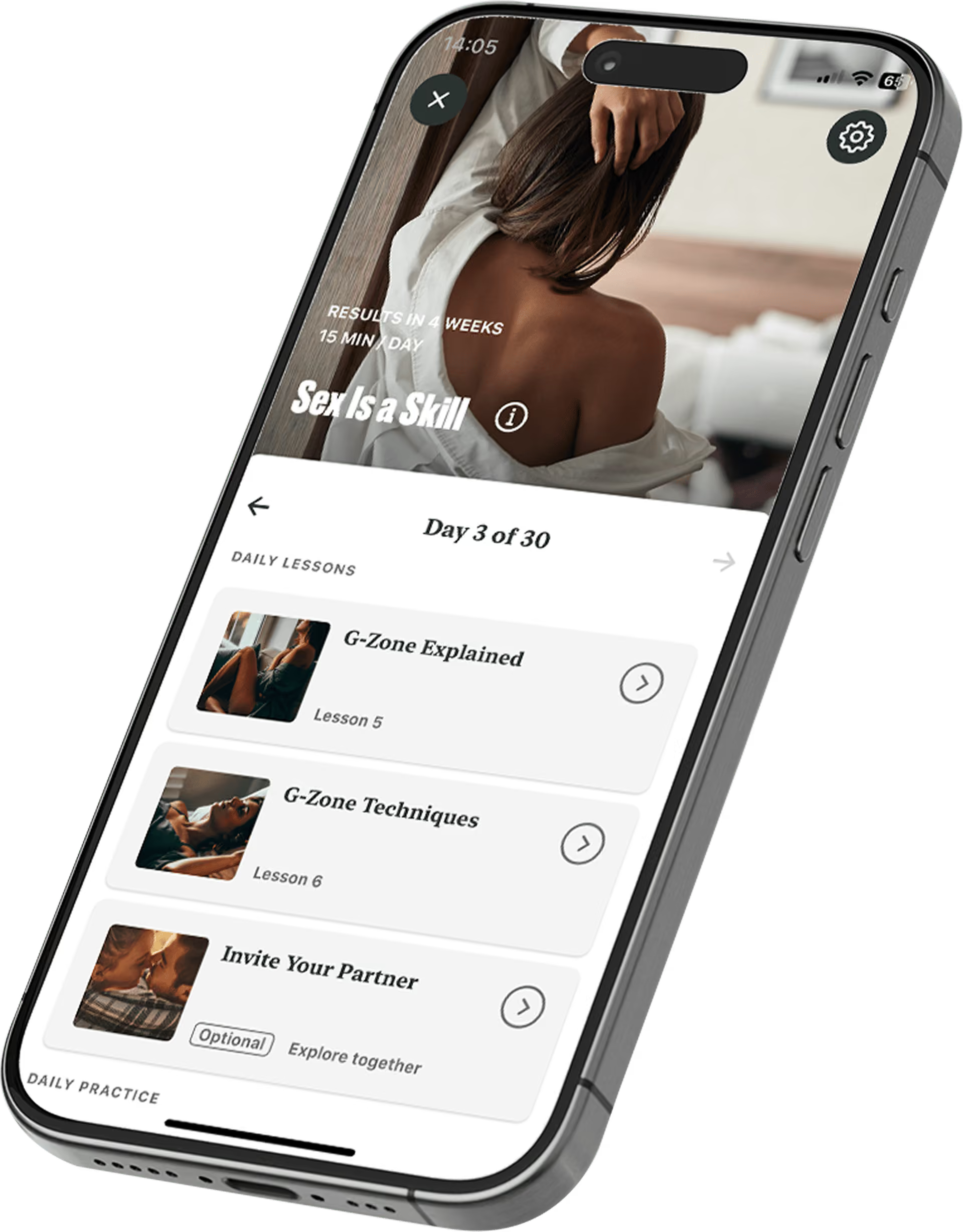
Everything above is knowledge, and knowledge is the cheap half. Sex is a Skill is the program that turns it into a sequence you actually run — thirty numbered days, fifty lessons and thirty practices, inside The Coach app.
You know which stage costs you. The plan you get is built from what you answer, not from an average.
It is the model Sex is a Skill opens with on day one, and the gate is plain: rush or skip one stage and orgasm becomes unlikely, or unsatisfying. The timing is hers. No two women run it the same way.
Ask how to make a woman orgasm and you get a technique. Stage four is where the technique stops mattering: a long flat stretch, her breathing steady, her hips settled, nothing that looks like building. It reads like a stall, and the instinct is to do more — faster, harder, somewhere new. That instinct is the most reliable way to end it. What the stage actually needs is for you to read her instead of adjusting her, and there are five things to read.
None of these tells you to change anything. They tell you that what you are already doing is working — which is a different instruction, and a much harder one to follow. It has a name, the “Don’t Change It” rule, and it applies to hands, mouth and hips alike. If your route to this stage is usually oral, the first few minutes run differently, and that sequence is set out in how to eat her out.
Holding that rule while she reacts is most of what how to be better in bed for men comes down to.
Two neighbouring questions are covered on their own: what it takes to please a woman across the whole thirty days, and how to thrust during sex once you are already inside her.
The plateau is not a pause. It is the part of the arc that decides whether there is a peak at all.
Four things make her orgasm learnable rather than lucky. None of them is a trick, and none of them came out of a magazine.
Female orgasm runs in six stages, from curiosity to recovery, each with physical signs you can see: swelling, deeper breath, hips that start to move. Skip one and every stage after it gets harder.
The clitoris is not a button. It has a glans, a hood, a shaft and internal bulbs and crura, and over 90% of her orgasms involve it even during penetration. Knowing where it goes changes pressure, angle and speed.
Her body opens only when her mind feels safe and attuned. Which is why the first stage is about invitation, and why cutting it short costs you the two after it.
Lead with sensation, not words — pressure, rhythm, stillness, the way you hold her eye. Save the question. There are three windows for it, and the middle of things is not one of them.
Most of what gets written about how to make her cum stops at the first one. Sex is a Skill spends five consecutive days past that point, days sixteen through twenty, and what it adds there is not a bigger technique. It is a set of resets, and every one of them is about doing less.
Nothing here promises a repeat. What it does is stop the first orgasm from being the accidental end of the evening. These are days sixteen through twenty, in that order, each with a practice attached.
From a survey of The Coach users who finished their first four weeks:
Real reviews from men using the program, trimmed for length and never reworded.
“At 61 years old I thought I knew a lot about female anatomy and sex, it turns out I was WRONG! While I have been quite successful in helping women reach orgasm in the past, it turns out it was more from luck than any skill on my part.”
“I have learned so much from your 30 day presentation, I have started implementing some of the points I have learned. Slow down, connect, it’s not about me it’s about learning her body. This gives me a new life thank you!!!”
“Excellent coaching! When it came time to apply what was learned things clicked and things worked just like I was coached it would. Just as important as the techniques, being attentive and listening and observing and staying consistent in those moments was absolutely crucial.”
“I can’t express how much this class helped me out with knowing and understanding my wife’s ‘body’, my game was on point but after the coach class, my wife’s exact words were ‘you are FIRE and I’ve never been so wet’, her words. I recommend this to get more in tuned with your wife.”
What they got was not more tips. It was the thirty days, in order, with something to do tonight.
The Coach is built with clinical researchers, certified sex therapists and medical professionals, including practising urologists.
Dr. Justin Lehmiller
PhD in social psychology and senior research fellow at the Kinsey Institute.
Dr. Jessica Yih
Urologist and director of women's sexual health and male infertility at UCI.
Dr. Kirti S. Patel
Board-certified ob/gyn and host of The Gynarchy, a women's-health podcast.
Cameron Fraser
Australia's leading men's sex coach, specializing in male sexual wellness and performance.
Dr. Paula Hall
Accredited sexual and relationship psychotherapist, registered with leading professional bodies in psychotherapy.
Natalie Goldberg
Certified sex and family therapist dedicated to improving intimate relationships and personal well-being.
Dr. Justin Houman
MD, UCLA-trained urologist and male reproductive specialist focusing on sexual health.
Dr. Amy Pearlman
Board-certified urologist specializing in male sexual wellness, performance, and hormonal health.
Start further back than feels reasonable. Most of the time the problem is not the technique at the end but the arousal at the beginning: the deeper zones do not respond to a cold start, and direct clitoral contact before she is ready registers as too much rather than as more. Give the first stages real time, find one kind of touch that gets an answer, and hold it. And be honest: nobody can promise a particular outcome for another person’s body.
The orgasm itself runs ten to fifty seconds. Everything before it has no fixed length, and we deliberately don’t put one on it: the practices run ten to thirty-five minutes and are about noticing, not about hitting a time. The one number worth carrying is that the flat stage before the peak lasts longer than you think it does.
Not in the middle. Questions mid-way pull her out of her body and into her head, which is the opposite of what the stage needs. There are three windows instead: before sex, when it is a conversation rather than a test; just after she comes, when the answer is specific; and mid-play only if she is genuinely relaxed, asked without stopping what you are doing.
No. Inside the practices the goal is never orgasm and never “doing it right”, and that is on purpose. Speed is not a lever you have. What you can change is whether she gets through the stages without one of them being cut short, and that usually takes longer at the start and less effort at the end.
Stillness and silence are on the list of signals that she is close, not signals that she has lost interest. The mistake is reading the quiet as a stall and changing something to fix it. Hold what you were doing, keep breathing, and let the quiet be the answer.
Yes. For around seven in ten women, oral is the most reliable route there is. The sequence is different enough to be its own thing: the first minutes are deliberately not where you would put them, and the finish has a rule of its own.
Sex is a Skill: thirty numbered days inside The Coach — fifty lessons and thirty practices. Days one to six are anatomy and hands, seven to twelve are oral, thirteen to twenty-two are what happens during sex, and the rest is your own body and how you lead. The app is paid, and the plan you get is built from your answers to the quiz.
Nothing at the start. Day five suggests lube, day twenty-nine wants a few household objects, and a toy turns up wherever she wants one — but none of it is required to begin. A partner, mostly yes, and that is the honest answer rather than the marketing one: twenty-eight of the thirty practices are written for two people in the room. Two are solo. Between partners you can read the whole thing, but you’d be reading it, not running it.
Yes, in the store you bought it through — App Store or Google Play — the same way you manage any other subscription there.
Two ways. Email support@the.coach and a real person on our team gets back to you — usually within a day. Or open the app, go to the Today tab, tap your profile, and hit Support. Both land with the same people.