How to Have Multiple Orgasms:
The First Two Minutes Decide It

Somewhere between ten seconds and two minutes after you come, the clitoris is too sharp to touch. That is where almost every session ends — not because the body is finished, but because the one thing that was working has stopped working, and nobody wrote down what to do with your hand in the meantime. Nothing shut down. There is no long refractory hour in a female body; sensitivity has simply moved, and the second orgasm is usually waiting somewhere the first one was not. The program’s answer is not to push through. Cover the whole vulva with your palm, hold still, wait for the sharpness to pass — and then begin again as though you had never touched yourself before.

Get my orgasm plan
4.7
1M+
Downloads
7,000+
User reviews

What Multiple Orgasms Actually Are, and Why the Second One Feels Different

A multiple orgasm is not one long climax stretched out. It is a series of distinct peaks, each running through the same build, plateau, release and short resolution — and the reason a female body can do it is that the shutdown phase afterwards is brief rather than long. What catches everyone out is the thing that changes in between.

  1. Several peaks, each with its own build. Each builds and releases on its own. The pattern varies: some arrive minutes apart, some in rapid waves, some layer over each other like something rolling through the pelvis.
  2. There is no long shutdown. A female body can re-enter arousal within seconds or minutes. Nothing has to be waited out except the sensitivity, and that runs on a much shorter clock than people assume.
  3. The clitoris changes first. Straight after orgasm it is often too sharp to touch, sometimes almost numb, sometimes both inside the same minute. That is thousands of nerve endings having just fired, and it passes.
  4. Which means the technique has to change with it. The single most common mistake is carrying on exactly as before. The body is not the one that was there two minutes ago, and the touch that worked now lands as too much.
  5. The second one usually comes from somewhere else. Internal pressure often rebuilds arousal more smoothly than external touch right after an orgasm. The course’s name for doing that deliberately is the Switching Technique, and it is the most reliable method in the lesson.
  6. This is physiology. Nobody is chosen for it. What separates women who have multiple orgasms from women who have not had one yet is very largely what they did in the two minutes after the first.

So the useful question is never how to have more of them. It is what your hand is doing between them.

Where the Multi-Orgasm Material Sits in Sex is a Skill for Her

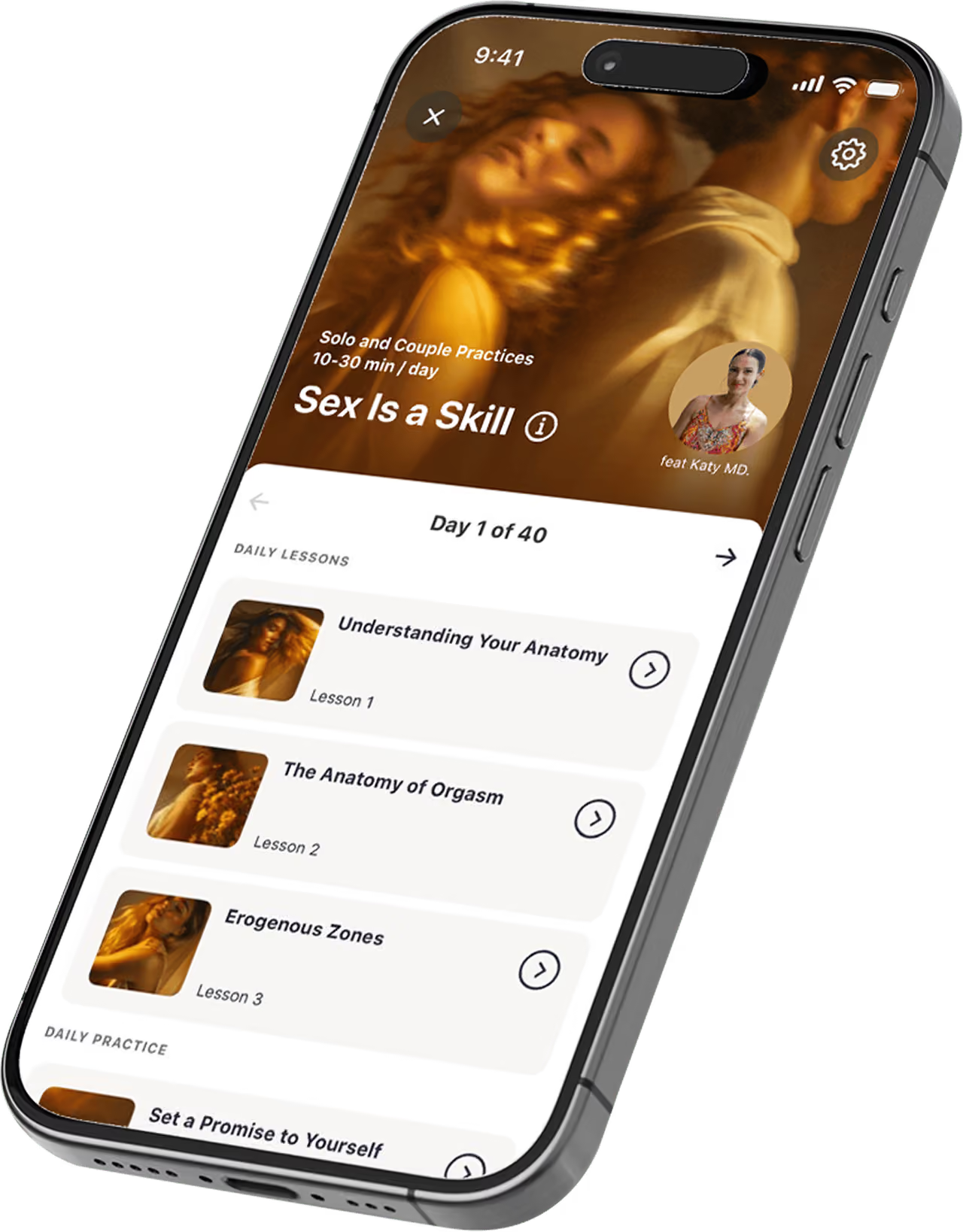
Sex is a Skill for Her is the women’s program inside The Coach, and it runs in three parts: your own pleasure first, his body second, leading the connection third. Everything below lives in the first part — a lesson on what changes after orgasm, a practice of twenty-five to thirty-five minutes built entirely around the second wave, and the edging lesson that feeds both. The app is paid.

  1. Answer the quiz. A few questions about how your body builds, and what it does immediately afterwards.
  2. Get the sequence in order. What to do in the recovery window, then how to rebuild, then where to switch — each a lesson and a practice, ten to thirty-five minutes at a time.
  3. Train the muscle underneath it. A responsive pelvic floor intensifies the contractions themselves, and the Kegel Journey inside the app is where that part happens.

A minute of questions, then the sequence for your own body.

The quiz asks how you build and what happens straight after, and returns the plan built on the answer.

Get my orgasm plan

How to Have Multiple Orgasms: Recovery, Rebuild, Rediscovery

Three phases, in that order, and the first one is where almost everybody stops. It has a clock — somewhere between ten seconds and a couple of minutes — and it has specific instructions for a hand that suddenly has nothing obvious to do.

  1. Recovery: diffuse, do not stop. Stopping all contact lets the arousal fall away. Diffusing keeps it alive while the sharpness settles, and the course names three ways to do it.
  2. The Palm Hug. The whole hand cupped over the vulva, covering everything and pressing nothing. This is the default, and for most women it is the only one they ever need.
  3. Lip Strokes and Still Pressure. Slow glides between the labia without touching the clitoris; or a warm hand or a switched-off toy resting in place with no movement at all. Warmth and weight, no stimulation.
  4. Rebuild: modify what worked. Slower. Less pressure. More indirect. And the clitoris approached through something at first — lubricant, the labia, a layer of fabric — rather than head-on.
  5. Or go inside instead. Front-wall pressure, a come-hither motion, a curved toy rocked in place. Right after an orgasm the outside is the crowded route and the inside is the clear one, which is why the second wave so often arrives through a different door.
  6. Rediscovery: this part is an experiment. New movements, a different zone, changes of tempo, sound, breath, fantasy. If it does not arrive, the session was still a session — nothing here has a pass mark.
  7. The Switching Technique, in order. First orgasm from your main zone. Switch zones for thirty to sixty seconds — clitoris to front wall, front wall to nipples, or out to the thighs. Return when the nerves have calmed, build to the edge again, switch once more, then combine the two. That last step is where the second one usually lands.

Two responder types, and neither is better than the other: some women can carry straight on at the same rhythm and already know it. The rest need the window, softer contact and a re-warm — and that is by far the more common of the two.

Three things a second orgasm is not

Three assumptions that end the session before the body has finished with it.

01Assumption
A matter of trying harder. Effort is the reliable way to lose it. The second one arrives from a different place at a lower intensity, and pushing at the old one is exactly what keeps it away.
02Assumption
Proof of anything. Some evenings there are several, some evenings one, some evenings none and the afterglow is the whole event. The lesson refuses to treat a count as a result.
03Assumption
The same orgasm again. The second is usually described as deeper, warmer, more full-bodied and more emotional — a rolling wave rather than a sharp peak. A different experience.

What ends the session, and what keeps it open

What ends it

The same touch, at the same speed, on a clitoris that just changed
Stopping everything and letting the arousal drain away
Checking whether it is working yet
Deciding in advance how many there are going to be

What keeps it open

Broad, still contact — a palm over the whole vulva
Thirty to sixty seconds somewhere else, then back
Slower, softer and more indirect than the first time
No target, so there is nothing to miss

Nothing closed after the first one. Something moved, and the hand that worked before is knocking on the wrong door.

What Is a Blended Orgasm, and Why Two Zones Beat One

A blended orgasm is one that comes from more than one erogenous zone firing at the same time. The nervous system does not add the two signals, it multiplies them — which is why the result reads as fuller and more whole-body than clitoral pleasure alone. Four combinations the course names, and they work alone as easily as with someone.

Clitoris and the front wall

The most common pairing, and the one most women already half-do: external stimulation and internal pressure held at the same time rather than alternated.

Nipples, during anything else

Nipple stimulation runs on its own pathway, so adding it during oral sex or penetration stacks a second signal instead of competing with the first.

Front and back together

Clitoral touch with pressure on the perineum or just inside the anus. Deep pressure plus outer arousal is the combination that produces the heaviest, slowest version of it.

One zone each

Partnered, a blended orgasm usually just means one of you covers the zone the other one is not on. Two zones is the requirement; who supplies which is not.

The method is four paragraphs long.

Doing it in the two minutes when your instinct says the evening is over is the part that takes practice.

Get my orgasm plan

How to Have a Full Body Orgasm: Senses, Temperature and Fantasy

A full body orgasm is what happens when several inputs are already running before the release arrives, so it travels through more of you than one point. The course builds it out of five ordinary levers, and not one of them is a technique.

  1. Stack the zones on the way up. A whole body orgasm needs more than one zone active during the build, not at the peak. Clitoris and front wall, nipples during oral, thighs and perineum — the stacking is done early or not at all.
  2. Reboot the senses. Light, temperature, music, scent, fabric. Arousal rises in several directions at once when the room is helping, and a warm blanket under your hips earns its place.
  3. Use temperature deliberately. Warming lubricant for depth of sensation, cooling for a bright tingling one, warm breath on skin, cool fingertips after warm hands. Gentle scratching followed by soft stroking runs on the same principle.
  4. Put the lubricant somewhere unexpected. Nipples, lower belly, inner thighs. It wakes those areas up so they take part in the orgasm rather than watching it happen elsewhere.
  5. Edge once before you decide to finish. Each round of building and backing off stacks more arousal in the body. By the time you let go, the release gets described far more often as a wave that takes over than as a peak that arrives.
  6. Let a fantasy run underneath it. Not acted out, not shared, just running. It activates the half of arousal that is not skin, and it is the cheapest intensity multiplier in the lesson.

The result is heavier, longer, more emotional and easier to repeat, which is the honest connection between all of that and a second wave.

Edging for Women: Three Styles, and How to Tell Which One Is Yours

Edging is building close to orgasm, backing off before the point of no return, and repeating until you decide to let go. The edging instructions for women in this program arrive as three named styles rather than one method, because the right one depends on something specific: what your arousal does when you stop.

  1. Pause and Rebuild. A full stop before the peak, all genital touch off, the feeling allowed to fade completely, then a restart from warm-up. Thirty seconds or an hour; kissing and nipple play are fine during the pause. Best for the largest delayed release.
  2. Distraction Edging. Instead of stopping, move quickly to a different part of the body — thighs, hips, breasts. The surprise breaks the loop without shutting anything down. The course compares it to interrupting a sneeze.
  3. Continuous Edging. Never stop moving, just soften. Reduce the pressure, widen the surface — a palm, the side of a toy — and stay in the pleasure without going over. Best if you lose the orgasm entirely whenever you stop.
  4. How to choose. Quick to orgasm: pause, or distract. Lose it whenever you stop: continuous, every time. That is the entire selection rule, and it is worth knowing before the first attempt rather than after the third.
  5. The practice runs about twenty to thirty minutes. Long enough for three or four rounds, short enough for an ordinary evening. There is no minimum number of rounds and no prize for more of them.
  6. Finishing early still counts. If you go over the edge by accident, the session did what it was for. The point of edging is learning what your own arousal does at the top of the curve.

There is no edging audio for women here, and that is deliberate: this one is written rather than voiced, because it depends on you reading your own build instead of following somebody else’s clock. The practices that do arrive as a voice in your ear are our walkthrough of guided masturbation.

Simultaneous Orgasm: How Two Different Timelines Get Matched

A simultaneous orgasm is a matter of timing rather than of compatibility. Two bodies run on different clocks — his usually shorter, yours usually needing more build — so arriving together comes down to adjusting pace. Five adjustments do most of the work.

  1. Arrive already warmed up. Do not ask penetration to create the arousal. Kissing, clitoral touch, nipple play, fantasy, a few minutes of edging — whatever is already running when penetration starts is what makes the timing possible at all.
  2. Change the angle, not the effort. A pillow under your hips tilts the pelvis so the penetration angle moves toward the front wall. For a lot of women that single change is the difference between nice and actually finishing.
  3. Rock, do not bounce. On top, rocking back and forth keeps steady pressure on the front wall and produces clitoral friction at the same time. Bouncing produces depth, which is not what you are short of.
  4. Sexual Alignment, for the reliable version. Start in missionary, bring your legs together, press them gently against him. Every stroke then delivers internal and clitoral pressure at once, which is why the course names this one specifically.
  5. Complementary gels are a real lever. A cooling gel slows his build; a warming one speeds yours. Both are recommendations to buy rather than anything included, and together they do more for the timing than any amount of concentration.
  6. Do not change what is working. The moment just before orgasm — the course calls it the Approach — is fragile in a way his is not. Whatever motion is happening when you reach it is the motion that has to stay exactly the same. Not faster, not harder, not different.

Which makes the useful sentence a short one, agreed before anything starts: if I go quiet and tense up, keep doing exactly that.

What Four Weeks Actually Moved

From a survey of The Coach users who finished their first four weeks:

58%
Felt more connected to their bodies
55%
Said sex became much more satisfying
39%
Reported a higher libido
41%
Had stronger, more frequent orgasms

Four weeks is where those numbers came from.

Not a breakthrough evening — a habit that fits inside one.

Get my orgasm plan

What women say about learning their own body

Reviews from the App Store, Google Play and Trustpilot, published as written.

“The programs are super easy to follow and have taught me so much about my own body! Definitely recommend”

_sophIE_890

“I really have enjoyed these practices and as a professional soccer player and woman, having a strong pelvic floor is key for high performance, hip and core health and for future child bearing. Thank you for what you do and how you do it. Love being part of this community.”

Aleja Sanchez

“I have learnt so much about myself and relationships that I never thought was possible”

Melissa55

“I recently started using The Coach (for her) and am so pleased so far. The information included is educational and also so fun. I love that the lessons are broken down into small lessons making it easy to learn in whatever time you have, whether that be minutes or hours.”

Mel_Malone

Read all reviews

Who Checks What The Coach Teaches

Clinical researchers, certified sex therapists and medical professionals, including practising urologists, shape what The Coach teaches. Sex is a Skill for Her is the women’s curriculum in that library: what your body does on the way up, and what it does in the minutes straight afterwards.

Dr. Jessica Yih

Urologist and director of women's sexual health and male infertility at UCI.

Dr. Kirti S. Patel

Board-certified ob/gyn and host of The Gynarchy, a women's-health podcast.

Dr. Justin Lehmiller

PhD in social psychology and senior research fellow at the Kinsey Institute.

Dr. Paula Hall

Accredited sexual and relationship psychotherapist, registered with leading professional bodies in psychotherapy.

Natalie Goldberg

Certified sex and family therapist dedicated to improving intimate relationships and personal well-being.

Dr. Susie Gronski

Licensed physical therapist, certified sexuality counselor, and founder of a men's pelvic health clinic.

Dr. Gary Shlifer

DO, board-certified internal medicine physician specializing in preventative care, nutrition, and anti-aging.

Dr. Joshua Roland

MD, sleep medicine specialist, and clinical instructor at the David Geffen School of Medicine, UCLA.

Questions About the Second One

I have never had more than one. Does that mean I can’t?

No. The lesson treats it as physiology rather than as a talent: the shutdown phase in a female body is short, and what usually prevents a second orgasm is the touch continuing unchanged on a clitoris that has just turned hypersensitive. Most women who find it find it alone, because that is where experimenting costs nothing.

How long should I wait between them?

Until the sharpness fades, which is usually under a minute and sometimes barely ten seconds. Your body gives the signal, and it beats any clock. What loses the second one is waiting it out with your hands off, because the arousal drains away with the sensitivity — so diffuse the touch and keep it alive.

Is a blended orgasm just two orgasms at once?

No. Two zones fire together and produce one orgasm. What the nervous system does with two simultaneous signals is multiply them, which is why women describe it as heavier and more whole-body instead of as two of something. The pairing is usually ordinary: clitoral touch plus internal pressure.

Do I need a toy for any of this?

No. Fingers cover every solo step here, including the recovery touches and all three edging styles. A curved toy makes internal rebuilding easier for some women, and the warming and cooling gels genuinely help with timing — all of them recommendations to buy, never things the program includes.

What do I actually get in the app?

Sex is a Skill for Her, the women’s program, in three parts and delivered a lesson and a practice at a time — ten to thirty-five minutes each, several of them guided audio and some illustrated with video. The second-wave practice runs twenty-five to thirty-five minutes. The Coach is paid, and the quiz ends in checkout.

Is my data private?

Completely. What you do in The Coach stays in The Coach. No data is shared, and your activity is visible to no one but you.

How do I get in touch?

Two ways. Email support@the.coach and a real person on our team gets back to you — usually within a day. Or open the app, go to the Today tab, tap your profile, and hit Support. Both land with the same people.

More programs from The Coach

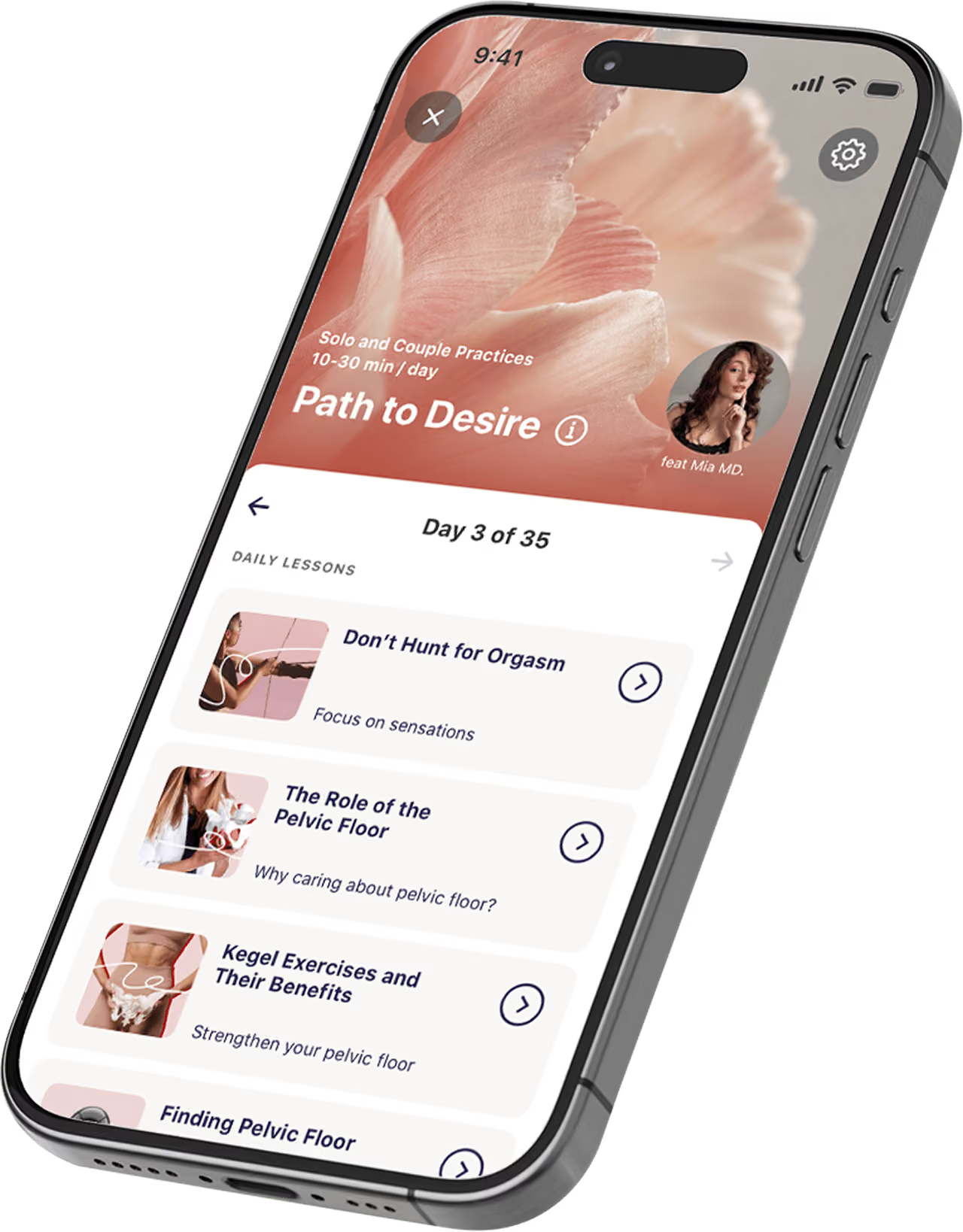
Path to Desire

Low desire isn't permanent. Bring it back in five weeks.

See the program

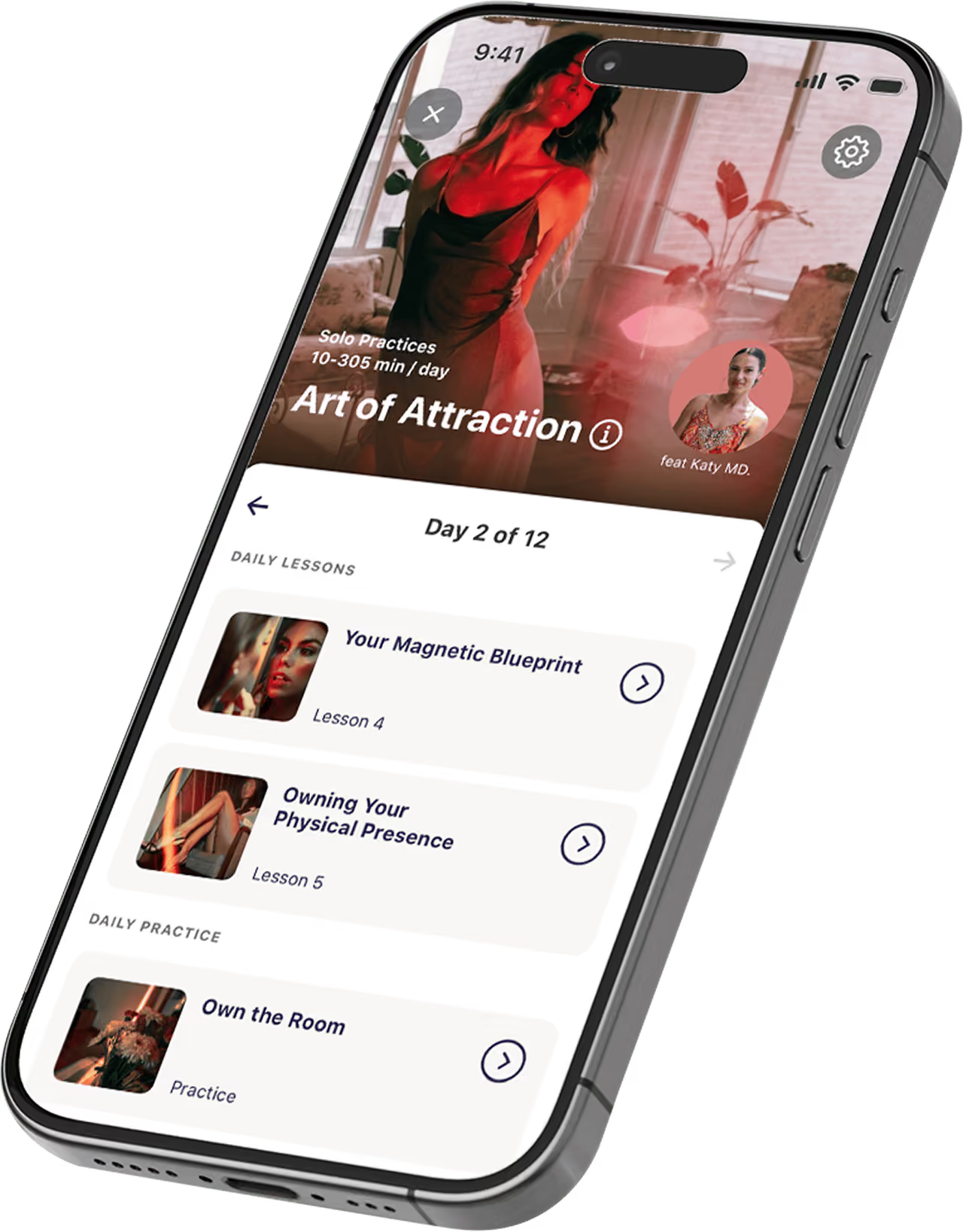
Art of Attraction

Attraction is energy, not looks.

See the program

The evening is not over when the first one is.

Three parts, and the first one is entirely your own — lessons and practices of ten to thirty-five minutes, including one built end to end around what happens after.

Get my orgasm plan