Change where you are.
Move from between her legs to her chest, or beside her. A new position is a new start, rather than a continuation she has to keep up with.

The moment she comes, most men treat as the finish line: roll off, reach for the phone, ask whether it was good. In Sex is a Skill, our thirty days on her pleasure, the next one to two minutes are the last part of the act, not something after it. That is the moment where she decides, consciously or not, whether it was truly satisfying. Aftercare is the name that stuck for it, and almost nothing the word brings to mind is what it asks of you.
Get my thirty-day planAftercare is what you do in the first minute or two after she comes: stay in physical contact, say one low, warm thing, and let her be however she is. Type aftercare sex into a search and every answer opens with kink. It isn’t just for intense play. It is emotional decompression, and it is for every time.
The arc that ends in that recovery stage is something we cover separately, in our guide to how to make her orgasm. Everything here is the part after the peak.
It is two minutes of doing very little, which is exactly why nobody practices it. The program gives it a day of its own and then keeps coming back to it.
Doing them on the night you are tired and pleased with yourself is what the plan is for.
None of them takes skill. All of them take deciding, in advance, that you are not done yet.
The word came out of kink, where a scene can be intense enough that the people in it need a landing. That is why every search for sex aftercare comes back with the same shape: a definition, a disclaimer that it applies to everyone, and a list of thirteen things. Sex is a Skill gets there by another road.
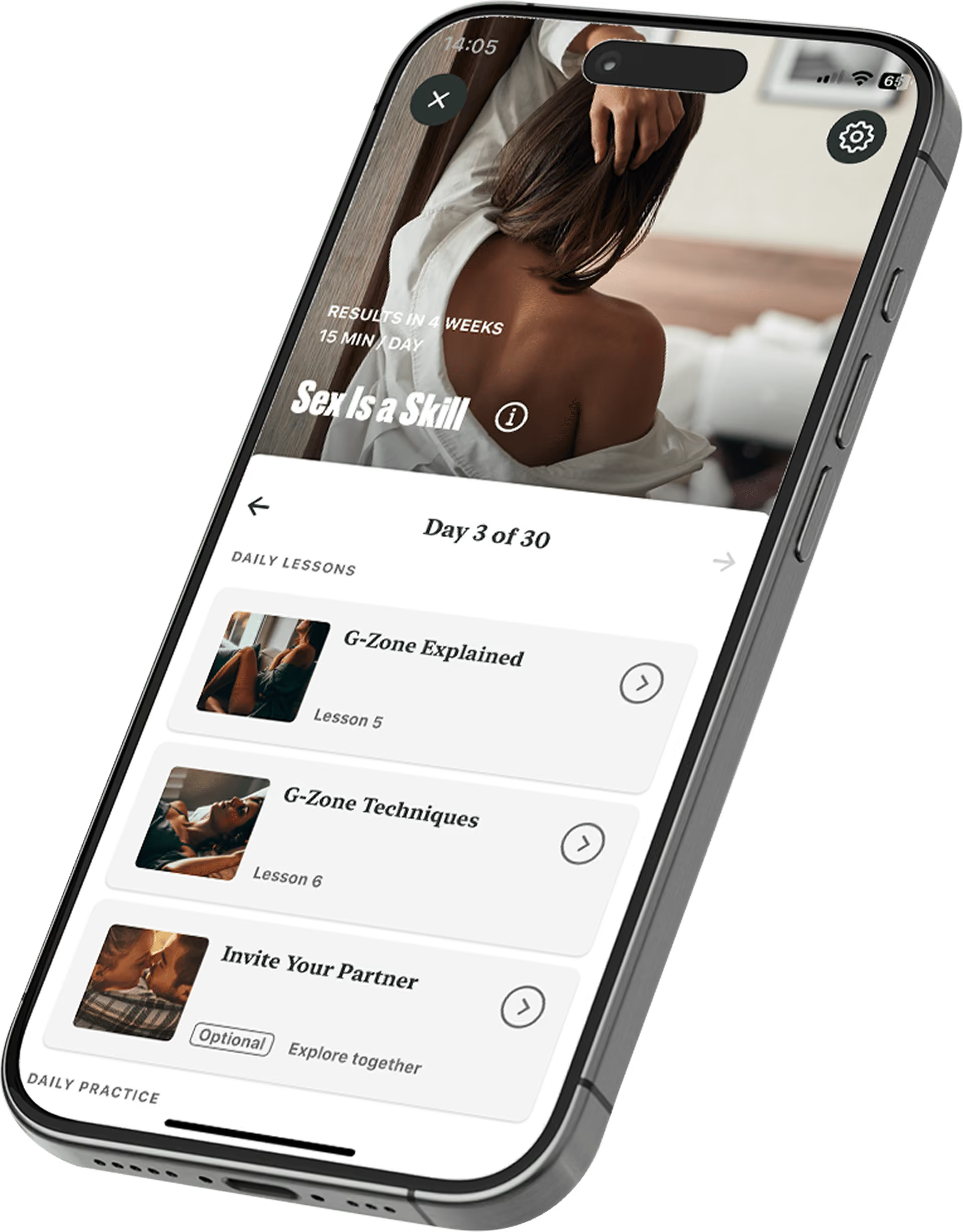
It puts aftercare inside the block on making her come with your mouth, because that is where it belongs. If you want her to crave sex with you again, you have to master the reset: the moment after pleasure where she decides whether it was worth it. Day twenty-seven says the same thing from the other end: craving isn’t built only during sex. It’s built by how you leave her.
Which makes this the cheapest skill in the whole thirty days, and the one with the longest tail. Nothing about it is hard to understand. What is hard is doing it at the exact moment your body is telling you the job is over. That is why it is a practice with a day number on it, and not a paragraph you nod at.
The act ends when she decides it did, and she has not decided yet.
Sometimes oral was the warm-up and the night is going on. The rule for that is to reset her nervous system before you build arousal again, instead of going straight from her peak into the next thing. Think of changing gear: don’t jam it. Three moves do it, and a fourth is what you do with the rest of the week.
Move from between her legs to her chest, or beside her. A new position is a new start, rather than a continuation she has to keep up with.
A few slow breaths, matched. It costs nothing, and it is the fastest way to bring her down and back.
Her neck, her shoulder, the inside of her wrist. Re-ground her away from the place that just fired.
The one part that happens outside the room: a message the next day keeps the thread alive. Not a script. A sentence that says you are still thinking about it.
Knowing it has never once kept a man in the bed. Thirty evenings of doing it have.
From a survey of The Coach users who finished their first four weeks:
Four weeks of short practices, run on the nights they were tired too.
Left as they were written on the App Store and Google Play, trimmed only for length.
“After only five or six lessons, I was tuned in to making the experience more pleasurable for her, which actually made me feel sexier! I’m not ashamed to admit that the Coach made me a better partner and lover.”
“I am grateful for the reminders and techniques to enhance and revitalize my love for my wife. Technique that makes you own the confidence that you’re doing the right stuff. Anatomy that we forgot about and sensory stuff that makes her squirm. Thank you”
“There’s a couple of uses for the app, but I liked how organized the section was on ‘Sex is a Skill.’ It has professionally drawn sketches to help you understand what is being described without looking graphic or distasteful. It has helped me up my game in the bedroom and I’m happy with my results!”
“At 61 years old I thought I knew a lot about female anatomy and sex, it turns out I was WRONG! While I have been quite successful in helping women reach orgasm in the past, it turns out it was more from luck than any skill on my part.”
Clinical researchers, certified sex therapists and medical professionals, including practising urologists, shape what The Coach teaches.
Dr. Justin Lehmiller
PhD in social psychology and senior research fellow at the Kinsey Institute.
Dr. Jessica Yih
Urologist and director of women's sexual health and male infertility at UCI.
Dr. Kirti S. Patel
Board-certified ob/gyn and host of The Gynarchy, a women's-health podcast.
Cameron Fraser
Australia's leading men's sex coach, specializing in male sexual wellness and performance.
Dr. Paula Hall
Accredited sexual and relationship psychotherapist, registered with leading professional bodies in psychotherapy.
Natalie Goldberg
Certified sex and family therapist dedicated to improving intimate relationships and personal well-being.
Dr. Justin Houman
MD, UCLA-trained urologist and male reproductive specialist focusing on sexual health.
Dr. Amy Pearlman
Board-certified urologist specializing in male sexual wellness, performance, and hormonal health.
Aftercare after sex is the minute or two of contact after she comes: a hand on her, one warm sentence, and no questions. The word came from kink, where it means bringing someone down after an intense scene. Sex is a Skill uses it for every session and gives it a day of its own, because that is the minute she is still making up her mind in. What it is not is hygiene. Washing, peeing, contraception are a doctor’s subject before they are an app’s, and we leave them to the doctor.
No. That is where the word was coined, which is why every article on it opens with a disclaimer. It belongs to every session: it is the emotional decompression that tells her she wasn’t being used and that she is safe to be real with you. A quiet Tuesday needs it as much as anything intense does. The intensity just makes the absence more obvious.
Let her. Giggly, teary, quiet and sleepy are all normal, and the instruction for all four is the same: don’t ask are you okay, just stay present. Crying after an orgasm is a release, not a complaint, and asking her to explain it turns it into one.
It keeps the thread alive, and it is the only part of the whole thirty days that happens outside the room. It does not replace the two minutes. Nothing you type the next day repairs a hand that went to the phone the night before.
Thirty numbered days, two short lessons and a practice on most of them, ten to thirty-five minutes at a time. Aftercare is day twelve, inside the oral block, and it comes back on day twenty-seven as part of making her want you more. The day you are on is tracked and the reminder lands when you set it. You need her in the room for twenty-eight of the thirty practices, and nothing else for this one. The app is paid, and the quiz ends at checkout.
Two ways. Email support@the.coach and a real person on our team gets back to you — usually within a day. Or open the app, go to the Today tab, tap your profile, and hit Support. Both land with the same people.